By GREGORY ZELLER //
The ultimate ultrasound competition returned to Long Island Feb. 22, with dozens of future physicians gathering at the Donald and Barbara Zucker School of Medicine at Hofstra/Northwell for ZonoSlam 2.
 Representing the Zucker School of Medicine and six other medical institutions, the 125-plus medical students showed off their skills with high-tech ultrasound equipment – and their ability to remain cool under pressure – in a second-annual competition sponsored by Northwell Health’s Department of Radiology and organized by the Zucker School’s Ultrasound Interest Group.
ZonoSlam is the only medical school-based ultrasound competition in the New York metropolitan area, according to Hempstead-based Hofstra University. The inaugural competition in 2024 attracted roughly 80 medical students – only about two-thirds of the 2025 field.
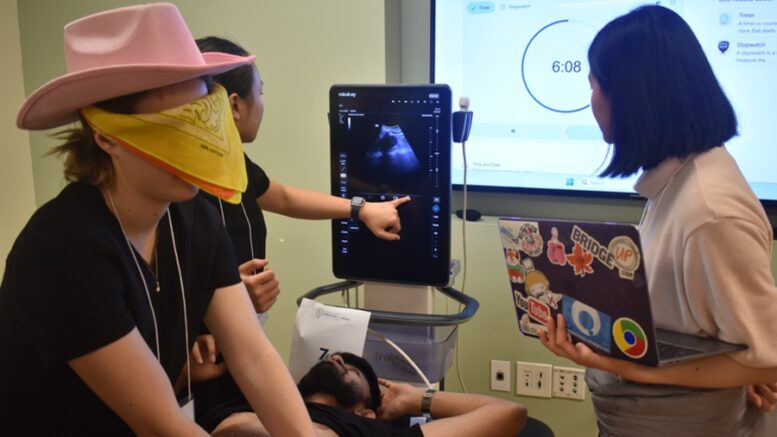
This year’s larger turnout was tasked with not only showcasing their medical-imaging abilities but doing so while clearing oddball competition-oriented hurdles – scanning while blindfolded, deciphering charades, even hula-hooping.

David Teng: Students shine.
Such silly challenges would never emerge in a real-life healthcare setting, of course. But chaos often reigns in scenarios where ultrasound scanning, a fundamental tool for nearly all medical specialties, is required – and there’s nothing wrong with adding a little joviality to the super-serious business of studying medicine, according to fourth-year medical student Crystal Cheng, co-chairwoman of the Zucker School’s Ultrasound Interest Group.
“Having fun while learning helps you to remember,” Cheng noted. “The combination of fun, enthusiasm and a competitive environment ensures that students will retain the knowledge and skills they practiced during ZonoSlam.”
Cheng worked closely with fellow fourth-year and USIG co-chair Ashley Lamba to plot out the unique combination of essential point-of-care skills and engaging challenges. Other not-exactly-healthcare-focused aspects of the second-annual Ultrasound Olympics included rounds of bingo, a three-legged race and jump-rope competitions, all intertwined with real tests of ultrasound proficiency.
By adding those additional stressors, the competition actually doubled down on the ability to display critical skills – anatomical knowledge, hand-eye coordination, attention to detail and more – under unexpected pressure.
Increasing the number of participating teams from 16 to 25 also added some pressure – at least, new “logistical challenges,” according to Lamda. But it also gave organizers a further chance to stretch their creative legs.
“We expanded the games into additional rooms on campus to accommodate the increased number of students and judges,” the co-organizer noted. “And we developed new, challenging and fun games.”
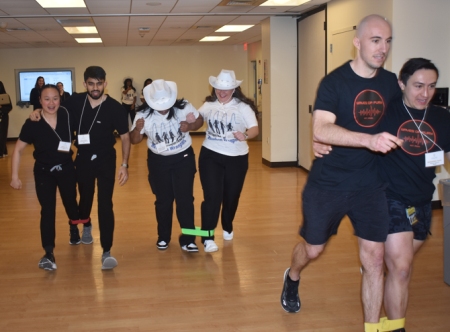
Legwork: Future physicians compete in a three-legged race at the ZonoSlam Ultrasound Olympics.
With Cheng and Lambda leading the way, the competition was “entirely student driven,” according to Zucker School Pediatrics Professor and ZonoSlam faculty advisor David Teng.
“I’m always impressed by our students, but the Ultrasound Interest Group always knocks it out of the park,” Teng said. “From start to finish, they coordinate, plan and execute every aspect of this amazing event.”
“The students are very passionate and committed to the ultrasound program,” added Zucker School ultrasound instructor Radha Persaud, who mentored both the student organizers and participating Zucker School teams.
“It is rewarding to witness their growth from first-year ultrasound sessions to clinical rotations in their third and fourth years, and to see how their skills and passion have developed,” Persaud added.
Participating schools included New York University’s Grossman School of Medicine, the New York Institute of Technology’s College of Osteopathic Medicine, Rowan University’s School of Osteopathic Medicine, Stony Brook University’s Renaissance School of Medicine, the Northwell School of Diagnostic Medical Sonography and New York Medical College.
Based on a points-scoring system, the “Probe Zuckers” from the Zucker School won Olympic gold, while the Renaissance School’s “Ahmad’s Attenuators” took second-place silver. The Zucker School’s “Scandits” finished in third.
But all of the participating teams demonstrated ultrasound proficiency, according to Teng.
“[ZonoSlam] is a prime example of their dedication,” the Zucker School faculty advisor said, “and (our students’) motivation to showcase our school and the importance of ultrasound.”