By GREGORY ZELLER //
Another round? Maybe not, according to the latest Mount Sinai South Nassau Truth in Medicine Poll.
 Released this week, the poll reports that a majority of New Yorkers are considering drinking less alcohol, or encouraging others to drink less, or both, following then-Surgeon General Vivek Murthy’s January warning about the connections between alcohol consumption and cancer.
Murthy, who was first appointed to the surgeon general post by President Barack Obama, was fired by President Donald Trump just months into Trump’s first term. He was reappointed by President Joe Biden in 2021 and announced his resignation after Trump won re-election last year.
Before leaving the office in January, Murthy – a Harvard University magna cum laude graduate and former vice admiral in the Commissioned Corps of the U.S. Public Health Service – issued an advisory linking booze to seven different types of cancer and labeling alcohol consumption the nation’s third-leading preventable cause of cancer, behind tobacco and obesity.
Rear Admiral Denise Hinton, a former U.S. Food and Drug Administration chief scientist and U.S. Air Force Medical Service Nurse Corps veteran, has served as acting surgeon general since Jan. 20, while Trump’s latest nominee, former CityMD medical director and Fox News contributor Janette Nesheiwat, awaits confirmation.
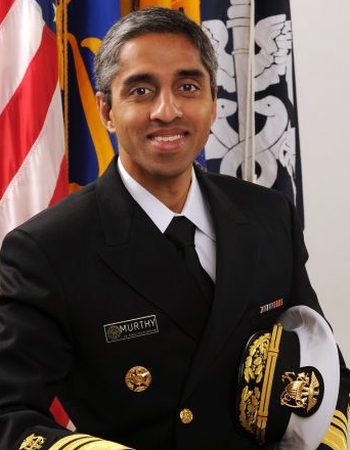
Vivek Murthy: Drinking is no game.
But Murthy’s bombshell advisory – including a call for cancer-related warning labels to be placed on alcohol products, which has not happened – has outlived his term.
Adding gravitas: a February report from the World Health Organization/Europe, which calculated 800,000 annual alcohol-related deaths in the WHO/Europe region and agreed that “prominent health warning labels on alcoholic beverages are essential for raising awareness that consuming alcohol can lead to cancer.”
Enter the first Truth in Medicine poll of 2025 – and 23rd overall in the long-running public-perception series, which dates back to 2017, before Oceanside’s South Nassau Communities Hospital became the Long Island flagship of the New York City-based Mount Sinai Health System.
Sponsored by Bethpage-based FourLeaf Federal Credit Union and conducted by Louisiana-based strategic research firm LJR Custom Strategies, the new poll queried 600 Long Island and New York City residents by phone between Jan. 26 and Jan. 30 – after Murthy’s recommendations went public but before WHO/Europe issued its concurring opinion.
According to the LJR’s tally, 57 percent of respondents reported consuming between one and seven drinks per week, 22 percent reported consuming between 8 and 14 drinks per week – and 51 percent said they would consider drinking less alcohol, or encourage others to reduce consumption, based on the former surgeon general’s advice.
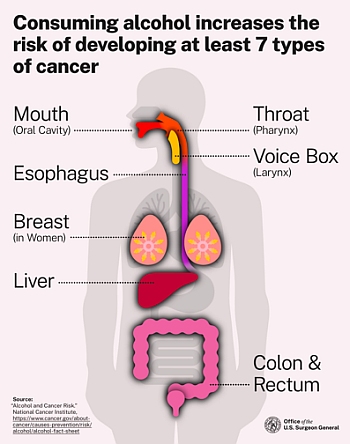
Down the hatch: Alcohol consumption is directly related to seven different types of cancer. (Source: U.S. Department of Health and Human Services)
Despite that slight majority, the poll indicated a difficult road ahead for public-health officials hoping to reduce alcohol consumption. While almost half of the respondents acknowledged that they’d heard about the then-surgeon general’s warning, and 58 percent agreed that alcohol can lead to other health risks (like overeating and smoking, the other two main cancer risks), only 46 percent said they believe that alcohol use increases cancer chances.
Such hedging only adds to the danger, according to Mount Sinai South Nassau President Adhi Sharma, who is unambiguous about the relationship between booze and cancer.
“Alcohol is a carcinogen,” Sharma said Wednesday. “So, the more alcohol a person drinks – particularly over time – the greater will be his or her risk of developing an alcohol-associated cancer.”
That’s supported by the American Association of Cancer Research’s Cancer Progress Report 2024, which noted that 40 percent of all U.S. cancer cases are associated with modifiable risk factors (such as alcohol consumption), and National Institutes of Health statistics noting that approximately 5.5 percent of all new cancer diagnoses – and 5.8 percent of all cancer-related deaths – can be attributed to alcohol consumption.
Sharma also applauded the notion of adding cancer warnings to alcohol-product labels, as per Murthy and WHO/Europe’s wishes. Based on a federal law enacted by Congress in 1988, current health-warning labels on alcoholic beverages only note that alcohol consumption impairs the ability to operate motor vehicles and heavy machinery and increases the risk of birth defects when consumed by pregnant women.
 “It would be prudent to add the cancer risk to the warning label,” Sharma said, noting the “dual effect of reducing alcohol-related accidents as well as a range of serious health complications, such as liver and heart disease, stroke, depression and brain damage.”
Label warnings could have a dramatic effect: Fifty-four percent of poll respondents said they generally believe warning labels on food and beverages.
That would take another act of Congress, which is not likely to do anything that threatens the bottom line of one of its largest lobbying blocs. But whether or not alcoholic-beverage health-warning labels are revamped, the seriousness of the former surgeon general’s warning is clear and should not be ignored, according to FourLeaf President and CEO Linda Armyn.
“We all know someone who has been impacted by a cancer diagnosis or alcohol-related illness or injury,” Armyn said in a statement. “As a staunch advocate and partner of Mount Sinai South Nassau’s mission to advance the public’s health and wellness, FourLeaf urges residents of Long Island and metro New York to give careful consideration to health information and advice that is solely focused on preventing life-threatening diseases, illnesses or accidents.”