By TOM MARINER //
It was as if I was transported to the Haas pit at the Formula One race in Monaco.
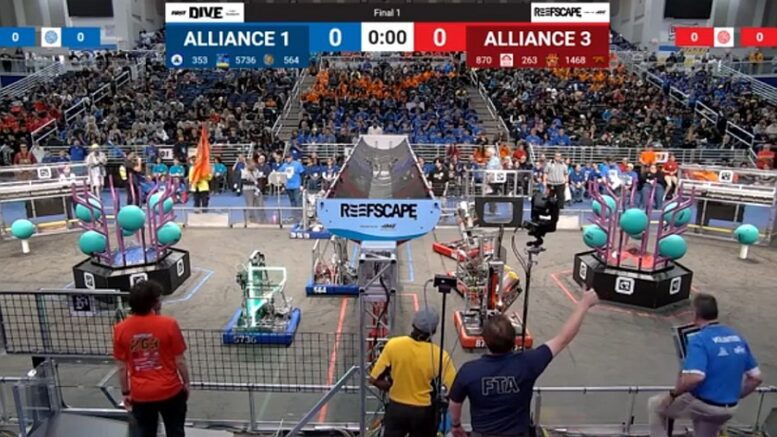
 Crews in logoed shirts, fervently tuning their complex vehicles and sending them into the fray. Drivers skillfully maneuvering their machines through intense qualifiers and nail-biting competition.
There were no roaring 1,000-horsepower V6 turbo-hybrid engines. But Hofstra University’s Mack Sports and Exhibition Complex was filled last month with the hum of robotic motors and the huffing puffs of pneumatic cylinders – and plenty of roars, too, from capacity crowds.
Welcome to the Long Island Robotics Regionals, the 48-team opening salvo of an international competition hosted by FIRST (For Inspiration and Recognition of Science and Technology).
Since its 1989 founding, international nonprofit FIRST has boosted more than 3 million youth participants in 110 countries. Since 1999, the regional round has been sponsored by FIRST Long Island (formerly the School Business Partnerships of Long Island).
Tom Mariner: Robo-cop.
And it may be the best answer to the question of reshoring U.S. manufacturing.
FIRST was founded by Dean Kamen, the holder of more than 1,000 patents, best known for creating the self-balancing Segway Personal Transporter (which contained microcontroller chips designed in Hicksville, by the way). His idea was to inspire young people to pursue careers in science, technology, engineering and mathematics by engaging them in exciting, mentor-based robotics programs.
“It’s not about the robots,” Kamen notes on the FIRST website. “It’s never been about the robots. We are not using kids to build robots. We are using robots to build kids.”
That matches nicely with Long Island’s unique relationship with manufacturing industries: Talents lie not just in product assembly but range from idea to production to soft skills like marketing and finance.
Kamen understood that the STEM spirit starts early. So, in 1998, through a partnership with LEGO Group owner Kjeld Kirk Kristiansen, the FIRST LEGO League was born, guiding students from early childhood through high school with increasing levels of complexity and competition.
The biggest takeaway from the student-run teams is that the skills that are acquired and developed are the same as those needed across the professional manufacturing spectrum. And robotics, it turns out, is also lots of fun.
 Every team I visited in the Mack “pits” was self-motivated and having a blast. There are adult mentors, whose involvement focuses mostly on things like tournament registration and participant safety – a critical area – but tapers off as the students build skills and confidence.
Young engineers rock the idea and development phases, lead fundraising efforts, promote team efforts and learn to operate their products safely and within regulatory standards. These responsibilities are virtually identical to everything I’ve seen through decades of helping to build commercially successful products and companies.
To keep the FIRST concepts fresh and vital, a different theme is applied to each year’s competition – not just colors and logos but a new “game” the robotics teams must play, filled with specialized tasks. This year, the theme was “Reefscape,” placing competitors in a virtual undersea world.
It’s all sponsored by California-based Haas Automation – the only American sponsor on the technologically advanced Formula One circuit – and supported by the Advanced Manufacturing Training Center at Suffolk County Community College.
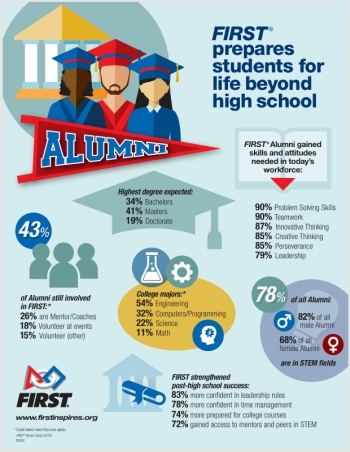
Going somewhere: FIRST participants tend to stick with science and technology through college and their careers. (Source: For Inspiration and Recognition of Science and Technology)
These are smart investments. According to a joint study by Deloitte and The Manufacturing Institute, the U.S. manufacturing sector could require up to 3.8 million new employees by 2033.
The FIRST program answers this call with hands-on technical skill development, alignment with career and technical education standards, copious industry partnerships and, of course, positive reinforcement in young minds toward STEM career choices. And it’s clearly working: 78 percent of FIRST alumni wind up working in STEM fields.
Ed Sottile, director of manufacturing engineering at Westbury-based Oerlikon Metco, said FIRST alumni always get a little extra attention when his company is hiring – illustrating the important relationship between these robotics competitions and the future of Long Island manufacturing.
“We’ve mentored and sponsored teams at both the robotics and First Lego League levels since 2008,” Sottile told me. “In hiring, we highly value FIRST graduates.”
Tom Mariner is the executive director of Bayport-based Long Island Bio.