By JEFFREY L. REYNOLDS //
If stock market swings are making you crazy, you’re not alone.
 Seven in 10 recently surveyed Americans said their financial stress is at an all-time high – and with global trade war and potential recession looming, there’s no relief in sight for the 162 million Americans (about 62 percent of U.S. adults) who own stocks as part of a portfolio, mutual fund, self-directed retirement account or 529 College Savings Program.
“I’ll never be able to retire” and “I can’t bring myself to even look at my statements” have become familiar refrains from everyday investors who were just starting to recover from the psychological and financial ups and downs associated with the COVID-19 pandemic.
Prolonged economic downturns and recessions have always proven to be detrimental to physical health and psychological wellbeing, sometimes spurring family conflicts, social isolation, hunger, homelessness and even suicide. But stomaching a stock market rollercoaster ride – the breathtaking climbs, jolting twists and sudden drops – might be just as disorienting and dangerous.
“Volatile markets can certainly stir up a variety of emotional responses,” says UBS Senior Portfolio Manager Jason Katz, a private wealth advisor from Roslyn. “Some people freeze, others panic … and then there are those who see opportunity in chaos.”

Jeffrey Reynolds: Invest in yourself.
That fight, flight or freeze reflex can activate the body’s stress-response system and trigger the release of cortisol, adrenaline and other stress hormones. Repeated exposure to these hormones can lead to anxiety, depression and other mental-health issues, as well as physical symptoms like headaches, digestive issues and muscle tension.
Left unchecked, those maladies can turn into cardiovascular disease, ulcers and other life-threatening conditions.
Katz urges his unsettled clients to take a long-term view of the market. Cold Spring Harbor-based psychotherapist Steven Pinto also encourages the finance professionals, high-level executives and investors he counsels to take a broader view.
“Market volatility doesn’t just shake confidence – it can bruise identity,” Pinto says, noting that when your performance or self-worth is “tied to external metrics like the S&P 500 or quarterly returns, a downturn can feel like a personal failure.”
The psychotherapist reminds clients that money isn’t everything and that exercise, creative expression, travel and a renewed focus on other life areas can restore balance and perspective and be the “ultimate cure-all” for whipsawed emotions.
That link between a person’s net worth and his or her sense of self-worth, though, is hard to break – and sell-offs often sends investors, especially those nearing retirement age, scrambling for help.
A nationwide study published last year by Ball State University researchers found that falling stock prices routinely leads to increases in psychotherapy sessions and antidepressant prescriptions. According to the study, which controlled for other economic factors, a stock price drop of 12.8 percent over a two-week period led to a .32 percent jump in psychotherapy visits billed to insurance providers and a .42 percent increase in antidepressant prescriptions.
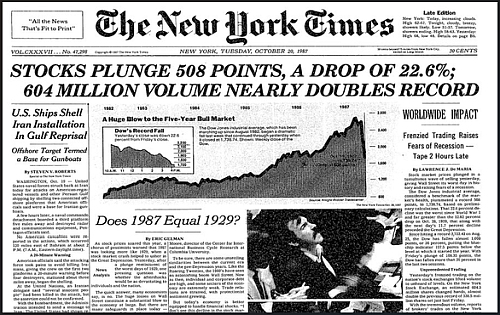
Black Monday: The U.S. Stock Market crash of 1987 drove psychiatric hospital admissions through the roof.
Another scientific paper found that hospital admissions in California for psychological conditions such as anxiety, panic disorder and major depression surge within one day of a big market drop. For example, on October 19, 1987 – when the U.S. stock market crashed and lost almost 25 percent of its value – psychiatric admissions in the Golden State spiked more than 5 percent. Nobody knows for sure whether those folks signed themselves out when the market rebounded the next day.
Bear markets can mess with your head, but even rallies – however modest – drive some to drink. A China-based study published last year backed up the downturn angst researchers found in California, but also found that even a 1 percentage point increase in daily market returns was enough to produce a same-day increase in alcohol-related emergency room visits.
With no signs of stock market stability on the horizon, money managers and mental-health professionals agree that limiting exposure to market news, resisting the urge to incessantly monitor portfolios and avoiding impulse moves – stick with your original investment plan! – is the best strategy for staying sane.
“Financial stress is real,” says Mark Nelson, executive director of the New York State Psychological Association. “Your mental health deserves as much attention as your money.”
Check in on your mental wellbeing instead of your financial statements, and you’ll likely feel a whole lot better.
Jeffrey Reynolds is the president and CEO of the Garden City-based Family and Children’s Association.