By GREGORY ZELLER //
All in all, it’s just another brick in … actually, scratch that. This BRIIC is a big deal.
 Welcome to the Biomedical Research, Innovation and Imaging Center, the shiny new science centerpiece of the New York Institute of Technology’s Old Westbury campus. University faculty and staff – and a high-caliber guest list of regional lawmakers, alumni and other VIPs – officially opened the BRIIC in a May 16 ribbon-cutting ceremony, marking the completion of a 20-month, $31 million renovation effort.
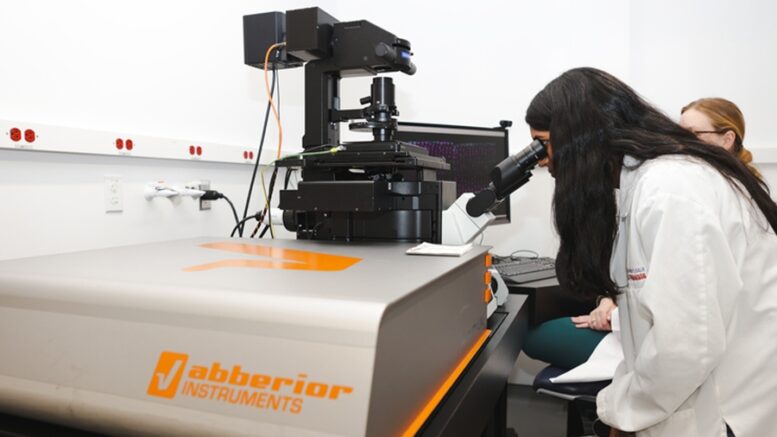
The infrastructure overhaul, which kicked off with a September 2023 groundbreaking ceremony, transformed the campus’ former 500 Building into an advanced imaging hub, packing a super-resolution 3D STED microscope (for “stimulated emission depletion”), a massive functional magnetic resonance imaging suite and other next-generation technologies focused on high-resolution microscopy.
The 20,000-square-foot space – a high-tech playground for researchers from New York Tech and other institutions – is built specifically to drive discoveries and potential new treatments for heart disease, cancer and Parkinson’s disease, among other challenging conditions.

Cut, that’s a wrap: New York Institute of Technology President Henry Foley and friends ceremoniously open the Biomedical Research, Innovation and Imaging Center May 16.
It also marks a major step toward the university’s goal of becoming a Carnegie-classified Research 2 university.
This year, the Carnegie Classification of Institutions of Higher Education granted Research Colleges and Universities status to New York Tech, indicating the school spends more than $2.5 million annually on research. Only 139 institutions have earned the classification system’s coveted R2 status, indicating at least $5 million invested into research and a minimum of 20 research-related doctorates conferred annually.
That lofty designation is now within reach, according to New York Institute of Technology President Henry Foley, who trumpeted a “transformative milestone for the … Long Island scientific community that has been years in the making.”
“The opening of our state-of-the-art BRIIC facility underscores the university’s commitment to research excellence and fills a critical need for high-resolution microscopy in our region,” Foley noted. “Moreover, it opens new doors for faculty and student research across multiple disciplines, symbolizing the kind of innovation and discovery that will help propel us toward becoming an R2 research institution.”
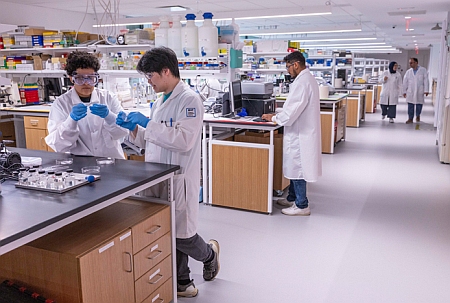
Come together: Scientists of different stripes can work side-by-side, thanks to BRIIC’s changeable workstations.
In addition to its high-tech imaging equipment, conference rooms and researcher offices, the BRIIC includes tissue-culture rooms, a room-size freezer facility, an autoclave – a machine built for scientific processes requiring elevated temperature and pressure – and 48 reconfigurable lab benches, specifically designed with “flexible infrastructure” to accommodate changing needs.
Its flexibility makes the BRIIC a multidisciplinary mecca where assorted scientists pursuing different discoveries can work side-by-side – an appealing prospect for the Empire State Development Corp., which contributed significant funding to the development project, including a $1 million Long Island Regional Economic Development Council award facilitating the purchase the 3D STED microscope, which gives researchers detailed closeups of cellular structures and processes.
“This cutting-edge research center enhances Long Island’s standing as a biomedical innovation leader,” ESD Board of Directors Chairman Kevin Law said in a statement. “Through the Long Island Regional Economic Development Council, we’re investing in New York Tech’s vision to attract top scientific talent, cultivate industry-academic collaboration and stimulate economic development in high-growth fields that will benefit our communities for decades to come.”