By MICHAEL H. SAHN //
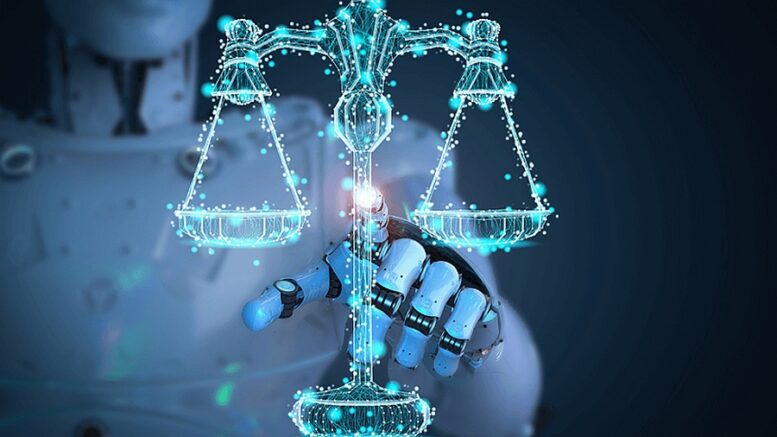
Generative Artificial Intelligence is revolutionizing the legal world – and maybe shrinking it.
 GenAI, as it’s known, is transforming how law is practiced, how legislatures adopt laws, how judges rule on cases and how law is taught. Lawyers who fail to master GenAI tools are suddenly at a huge disadvantage, and so are their clients.
It won’t replace lawyers with cyborgs anytime soon, but GenAI is absolutely streamlining legal services and simplifying tasks that lawyers have traditionally performed – potentially eliminating jobs for attorneys and other legal professionals.
Legal research is the most common use of GenAI. This technology instantly searches, analyzes and digests vast databases of legal precedents and authorities to guide lawyers in their cases.
Other GenAI applications draft documents, process discovery demands in litigation and organize information requests that often involve thousands of documents, in a remarkably short time. The technology is also being used for law firm management, billing and marketing operations.

Michael Sahn: Irreplaceable.
Big law firms have led the way on GenAI, but lawyers in middle and smaller firms are not far behind. According to surveys, the percentage of lawyers using AI has significantly increased over the past few years – one source predicts that by 2029, 60 percent of legal professionals will rely on GenAI in their daily work (and that number could reach 85 percent by 2031).
Long Island’s law schools are wisely integrating AI into their curriculum. At Touro Law Center, which calls itself a “pioneer in AI-enhanced education,” Dean Elena Langan has stated that students will be well versed on AI’s implications for their clients, the practice of law and the justice system. The Maurice A. Deane School of Law at Hofstra University has developed courses focused specifically on GenAI.
Many law schools are using AI programs that simulate the “Socratic” study method made famous in the TV show “The Paper Chase,” whereby students learn the law through a question-and-answer format. Instead of a professor, these programs use a chatbot.
New York courts are also diving headfirst into GenAI, to assist judges and clerks with research, document review and statutory interpretation.
To make sure the courts use GenAI properly, the New York State Unified Court System published regulations governing when and how judges and non-judicial employees may use GenAI in presiding over cases. The rules allow GenAI to be used to summarize cases and voluminous documents, draft simple orders, test a judge’s belief as to what the law is and brainstorm how a judge should rule regarding areas of law with which the judge may not be familiar.

Digital chase: Instead of this guy, 21st Century law students are being queried by chatbots.
The courts also use GenAI to check the work of lawyers who file GenAI-aided documents, seeking to cull out “deepfakes” and “hallucinations” such as false case citations or statutes that may be hidden in lawyers’ papers, whether inadvertently or not.
Some courts now require that lawyers disclose in their papers whether GenAI was utilized in the drafting. Others require an attorney certification that every AI-generated case has been independently reviewed for accuracy to avoid hallucinations.
Legislative bodies are also using GenAI to assist in research for new laws and regulations, create documents, edit draft laws and transcribe hearings and legislative proceedings.
The jury is out on whether GenAI will be used for “good” or “bad” – as framed in a Harvard law journal article, there’s both “promise and peril” in AI. It’s not clear whether this technology will benefit the legal industry and the public by increasing knowledge and access to the law, cutting costs, increasing access to the justice system and producing fairer results – or if it will create a two-tier, inequitable legal system unfairly benefitting those who can afford AI technology (and those who can master it).
But GenAI will never substitute the passion, dedication and commitment of a lawyer advocating a client’s cause. Cases and causes are won or lost by lawyers who craft the facts and the law to advocate for their clients. Technology will not replicate the “old county lawyer.”
Legal professionals must acknowledge that GenAI is here to stay, seize its opportunities and confront the challenges of this technology. But ultimately, justice and law come from people, not machines.
Michael H. Sahn, Esq., is the managing member of Uniondale law firm Sahn Ward Braff Coschignano PLLC, where he concentrates on zoning and land-use planning, real estate law and transactions, and corporate, municipal and environmental law. He also represents the firm’s clients in civil litigation and appeals.