Keep your cool: Welcome to Wednesday, intrepid innovators, and the midpoint of another bustling (and blustery!) week of socioeconomic progress.
It’s Nov. 3 out there, and with temperatures dropping to their seasonal norms, we’re here to warm your cockles with another toasty innovation review. Let’s crank it up!
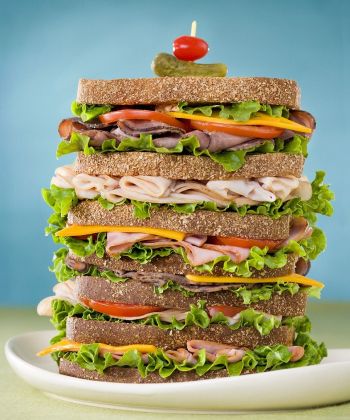
With a cherry (tomato) on top: Go ahead and pile on, it’s National Sandwich Day.
Gender blender: Not all innovation happens in the lab or office – so we warm up with National Homemaker Day, honoring the stay-home moms and dads striving for greater efficiency in their busy day-to-days.
Need further proof of its innovative nature? It used to be called National Housewife Day.
Lunch pad: No homemaker could be complete without mastering the art of lunch – so it makes perfect sense that Nov. 3 is also National Sandwich Day.
And since it’s really not so hard to slap some PB&J between two slices of bread, we’re pretty chill with National Stress Awareness Day, always lowering blood pressures on the first Wednesday in November.
About Times: It was a Saturday on Nov. 3, 1838, when the Times of India – known first as The Bombay Times and Journal of Commerce – printed its first edition.
The second-oldest Indian newspaper still in circulation (behind the circa-1822 Bombay Samacher) currently ranks as the world’s largest-selling English-language newspaper.
Dot’s all, folks: Three short dots, three long dashes and three short dots – radio-telegraph shorthand for “S.O.S.” – became the internationally approved distress call for ships at sea on this date in 1906.

Treasure chest: Caresse Crosby (born Mary Phelps Jacob) rewrote the women’s undergarment rulebook.
She’s got your backless: Signaling a new fashion trend – and a new era of comfort for women, freed at last from the painful whalebone corset – 19-year-old New York socialite Mary Phelps Jacob patented the modern elastic brassiere on Nov. 3, 1914.
Evacuate Tokyo! The most famous kaiju of them all – Godzilla, still the reigning, city-smashing King of the Monsters – first roared onto Japanese movie screens 67 years ago today.
Cruel intentions: And Sputnik 2, the second spacecraft launched into Earth orbit and the first carrying a terrestrial lifeform (a Samoyed terrier named Laika), blasted off from the USSR’s Baikonur Cosmodrome on Nov. 3, 1957.
While the mission is considered a success, it didn’t end well for Laika: Lacking the technology to safely land the space probe, flight engineers expected the dog to perish after about 10 days in orbit; mission telemetry suggests she only lasted two.
Winging it, eh: Canadian Air Force officer and ace World War I fighter pilot William Barker (1894-1930) – a notorious rule-breaker and fearless risk-taker who became the most decorated serviceman in Canadian military history – would be 127 years old today.

Knee pain: Kaepernick, problematic protestor.
Also born on Nov. 3 were Scottish chemist and physician Daniel Rutherford (1749-1819), the first to isolate gaseous nitrogen; Japanese chemist and industrialist Jokichi Takamine (1854-1922), the first to isolate adrenalin (known now as epinephrine); English surgeon Wilfred Trotter (1872-1939), a neurosurgery pioneer; African American artist Lois Mailou Jones (1905-1998), an influential painter, teacher and cornerstone of the Harlem Renaissance; and U.S. Army Brigadier Gen. Elizabeth Hoisington (1918-2007), one of the first two women to achieve the one-star rank.
Kneel deal: And take a bow knee, Colin Kaepernick! The former National Football League quarterback turned lightning rod American civil rights activist turns 34 today.
Wish the peaceful protestor well at editor@innovateli.com, where your news tips and calendar events are always welcome – even your political positions, as long as you express them nicely.
 About our sponsor: New York Institute of Technology’s profession-ready degree programs incorporate applied research, real-world case studies and professors who bring decades of industry knowledge and research into the classroom, where students and faculty work side-by-side researching cybersecurity, drone design, microchips, robotics, artificial intelligence, app development and more. Visit us.
BUT FIRST, THIS
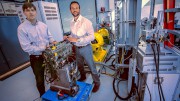
Man of steel: Laser beams, synchrotrons, X-rays, 3D-printed stainless steel and other high-concept tools and materials populate a new Stony Brook University study exploring the future of artificial alloys, and paths to making them stronger.
Published this month in the peer-reviewed scientific journal Additive Manufacturing, the study has a mouthful of a title – “Dislocation Microstructure and its Influence on Corrosion Behavior in Laser Additively Manufactured 316L Stainless Steel” – but a fairly simple concept: detecting defects in 3D-printed alloys at nanoscopic levels, perchance to make them better. Correlative synchrotron X-rays, electron microscopy and other next-level technologies play large in the study, which was authored by Jason Trelewicz, head of SBU’s Engineered Microstructures and Radiation Effects Laboratory, and scientists from Pennsylvania State University, Brookhaven National Laboratory (home of the National Synchrotron Light Source II) and Stony Brook’s Institute for Advanced Computational Science.
Trelewicz, also an associate professor of engineering and materials science in SBU’s College of Engineering and Applied Sciences, said the study serves two masters, proving 3D-printed stainless steel “exhibits an increased susceptibility to pitting” (compared to traditional stainless-steel alloys) and demonstrating that “multimodal synchrotron techniques” are now essential to improving the performance of additive-manufacturing materials. The full microstructural study, supported by the Office of Naval Research, is available here.

Please pardon our appearance: Gov. Hochul (at podium) praises the under-construction concourse.
All aboard: Continuing a tradition as old as politics (and railroads), Gov. Kathy Hochul on Sunday hopped aboard a Long Island Rail Road “test train” to highlight progress on the Metropolitan Transit Authority’s new East Side Access passenger terminal.
Set to open in December 2022, the 350,000-square-foot terminal and concourse – “the largest new train terminal to be built in the United States since the 1950s,” according to the governor’s office – will help increase the LIRR’s Queens-to-Manhattan capacity by 50 percent, cutting commute time from the eastern boroughs to Manhattan’s East Side by as much as 40 minutes. By providing eastern commuters direct access to Grand Central Terminal, East Side Access is also projected to reduce crowding at Penn Station and on subway lines serviced by the LIRR’s traditional NYC terminus.
First conceived in the 1960s and under construction since 2006, the project features 40 miles of new track, 13 miles of newly excavated tunnels and oodles of high-tech infrastructure, including 17 hi-rise escalators leading to the new concourse below Park Avenue. “Not only will we provide more options for our riders to the East Side of Manhattan, but we will be giving them a state-of-the-art facility beneath the existing Grand Central Terminal,” noted LIRR President Phil Eng. “The LIRR continues to be a leader in reducing pollution and stimulating New York State’s economy by getting people out of their cars and back to work across Long Island and New York City.”
POD PEOPLE

Episode 14: Hamilton, the non-musical.
There are many contributors to Stony Brook University’s vast commercialization ecosystem, but none more productive than David Hamilton, executive director of Stony Brook’s Clean Energy Business Incubator Program and chief operating officer of the university’s Advanced Energy Research and Technology Center.
Sponsored by frontline carbon-reduction leader (and CEBIP graduate) ThermoLift, Season 2 of Spark: The Innovate Long Island Podcast goes inside the incubators with one of the Island’s busiest innovators. Try and keep up!
TOP OF THE SITE
Looking up: As the 21st Century workforce evolves, public-private partnership UpSkill NY will train young Long Islanders to answer the call.
Same as the old boss: She’s been on the job for 16 months already, but “new” Stony Brook University President Maurie McInnis has, at long last, been officially inaugurated.
Subscription prediction: Thanks for forwarding this engaging newsletter to your innovation team, but you’ll be much happier when they have their own subscriptions – always easy, always free.
VOICES
Food industries are always ripe with innovation – and the veganism movement proves it, according to Tate’s Bake Shop CEO and Voices food anchor Nancy Pak, who sees healthful, forward-thinking changes aplenty in what we eat and how it’s made.
STUFF WE’RE READING
Fast start: On Day One of COP26, the United States and the EU vowed to slash methane emissions. The BBC gasses up.
Block(chain) buster: Is cryptocurrency the greatest innovation of our lifetime? Business Insider cashes out.
Hourly charge: Daylight saving ends this weekend – bad news for retailers. NPR shines bright.
RECENT FUNDINGS
 + Convergent Dental, a Massachusetts-based laser-tech developer focused on anesthesia-free, pain-free dentistry, raised $40 million in Series C funding led by Arboretum Ventures, with participation from existing investors including Long River Ventures and the Gund Foundation.
+ TurtleTree, a California-based biotech leveraging cell-based technology for milk production, raised $30 million in Series A funding. The round was led by Verso Capital.
+ Coterie Insurance, an Ohio-based insurance-tech company for small businesses, completed a $50 million Series B financing led by Weatherford Capital, with participation from RPM Ventures, Intact Ventures, Group 1001 and Alpha Edison.
+ Cambrian Biopharma, a New York City-based biotech, raised $100 million in Series C funding led by Anthos Capital and SALT Fund, with participation from Apeiron Investment Group, Future Ventures and Moore Capital.
+ Brave Health, a Florida-based behavioral-health services provider, raised $10 million in Series B funding led by City Light Capital, Union Square Ventures and Able Partners.
+ CompanyCam, a Nebraska-based photo documentation and communication app for contractors, closed a $30 million Series B funding round led by Insight Partners, with participation from JMI Equity and WndrCo.
BELOW THE FOLD (Fast Food Edition)
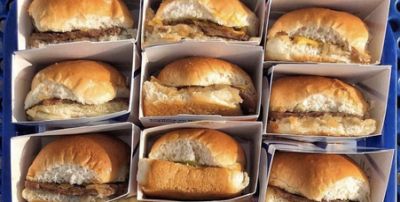
Sack lunch: A hundred years old, and you can still taste the onions.
What you crave: A century later, fans still can’t get enough White Castle.
Tacos in spaaaaace: Astronauts have harvested green chiles on the ISS, and used them.
Do you tip a robot? Your pizza may soon be delivered by a machine.
Have it your way: Please continue supporting the amazing institutions that support Innovate Long Island, including New York Tech, where your best future is made to order. Check them out.