By TOM MARINER //
The $99.7 billion movie industry and the $198 billion videogame industry both bank on computer-generated realism that was birthed on Long Island.
 One master innovator on the path to today’s amazing computer-generated graphics was Alvy Ray Smith, who recently keynoted New York Institute of Technology’s commencement exercises (and collected an honorary Doctor of Science degree).
In his May 22 keynote, Smith recalled the seminal role that New York Tech founder Alexander Schure played in the establishment of the institute’s Computer Graphics Lab, a before-its-time digital workshop of the 1970s and 1980s. The forward-thinking academician hired Smith (and other computer-science luminaries) and poured loads of money into the venture, but “neither Schure nor [New York Tech] have gotten the recognition they deserve,” according to Smith.
It’s pretty hard to argue with that.
When Walt Disney’s pioneering cartoon “Steamboat Willie” premiered in 1928, movie animation consisted of hand-painted backgrounds and “moving” objects on clear celluloid, painstakingly photographed frame-by-frame with the just the slightest shifts – fooling the eyes into seeing “movement” when displayed quickly on a screen.

Tom Mariner: Vision quest.
Disney’s great innovation with the black-and-white short was actually the inclusion of synchronized sound (and, of course, the introduction of a subsequently famous mouse). The animation process that created it was already established: rooms filled with artists working long hours to draw, paint, arrange and photograph the thing.
At the New York Tech Computer Graphics Lab, the idea was to let computers do this painstaking work. But neither the computing hardware nor software of time was up to the task – at first.
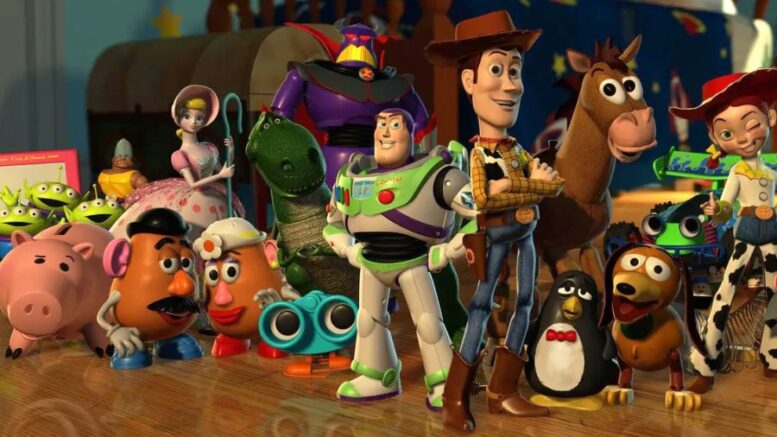
The world’s first computer-animated feature film, Pixar Animation Studio’s “Toy Story,” wasn’t that far off. But the 1995 hit would be made using computers with millions of times the processing power of anything they had in the Computer Graphics Lab’s early days.
Smith and Ed Catmull, another New York Tech (and Computer Graphics Lab) alum, co-founded Pixar after working together at Lucasfilm, helping “Star Wars” creator George Lucas bring computer graphics, digital video editing and digital audio deeper into the entertainment industries. (Lucasfilm, of course, has expanded these technologies in amazing directions.)
Catmull would eventually become president of Walt Disney Animation Studios and Smith would engage in some famous dust-ups with Pixar cofounders Steve Jobs and John Lasseter. Despite all the palace intrigue, though, Catmull and Smith continued to produce amazing computer-animation advances.
Among other things, Smith coined the term “digital light,” covering all forms of digital graphic expression. His main focus was big-screen animation, but the term now applies to everything from tiny characters on your phone to MRI images.

Alvy Ray Smith: Animated presence.
While things progressed inside New York Tech’s Old Westbury laboratory, eight miles away in Hicksville, General Instrument Microelectronics was helping to create a seminal part of the videogame industry: Mattel’s Intellivision platform.
Where Smith’s modus operandi was the mathematical methods of creating better digital images, ours was all about moving little dots, gathered into specific shapes, around a defined play field. It’s fair to say his way was better: General Instruments eventually sold off its advanced-graphics division to the Computer Graphics Lab, and Intellivision’s stick figures became the totally lifelike characters of today.
Using the graphical magic of new algorithms and other advances made at New York Tech, videogames achieve astounding levels or realism these days, and real-time movement under the control of individual players. Character motions and visual perspectives that would take weeks to assemble in “Steamboat Willie’s” days now happen in four-thousandths of a second.
And the “digital light” has spawned new advances in chip technology, while promising to animate entirely new realms as artificial intelligence catches up fast.
All of today’s orc armies and blasting spaceships and photorealistic environments owe a debt of gratitude to New York Tech’s Computer Graphics Lab. And while Smith and Catmull are no longer hanging around the campus (at least, not regularly), New York Tech’s de Seversky Mansion is alive and well with breathtaking computer-graphic applications.
Look no further than Transforming and Improving the Human Condition, The recent biotechnology conference, hosted by New York Tech’s College of Engineering and Computer Science, incorporated all kinds of advanced computer graphics, illustrating microscopic scientific breakthroughs with enormous clinical potential.
Who knows … maybe years from now, we’ll pay homage to Long Island’s graphically advanced biotech initiatives, the same way we adore Buzz and Woody today.
Tom Mariner is the executive director of Bayport-based Long Island Bio.