By DAVID A. CHAUVIN //
The incredible (and, depending on your POV, incredibly concerning) proliferation of partisan politics has had wide-ranging cultural and political consequences – and the art of political campaigning has certainly not been immune to the increasing tribalism.
 I’ve come to see this firsthand and in sharp focus, via the current campaign for New York’s Third Congressional District.
As executive vice president of ZE Creative Communications, I work for Robert Zimmerman – the “Z” in “ZE” and the current Democratic candidate for the Third District seat, opposite Republican candidate George Devolder-Santos.
While I have no official capacity in the campaign, I’m obviously following it closely. This has enlightened me to some of the realities of modern campaigning.
Midterm races, at least in recent history, usually go against whomever holds power in Washington – particularly, the side occupying the White House. To greatly oversimplify it, if a Democrat is president, Republicans do well in the midterms, and vice-versa. Famous examples include the 2018 “blue wave” with Donald Trump in office and the “Republican Revolution” in year two of Bill Clinton’s first term.
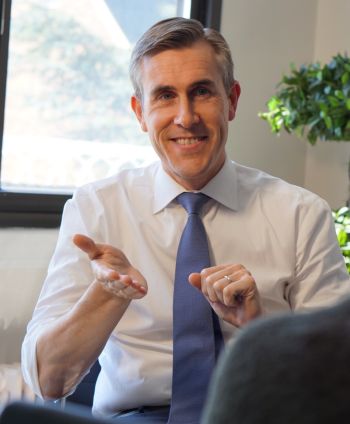
David Chauvin: Local boy.
Polling for the 2022 midterms show this theory holding – perhaps to a lesser extent, with Republicans a light favorite in the House of Representatives and several toss-ups in the U.S. Senate, with control of the higher chamber at stake.
What strikes me as different about this year’s campaign season is a pronounced strategy by candidates to distance themselves from federal politics – and in particular, from potential 2024 presidential candidates.
The are many reasons: intense partisanship, a lingering preference among the electorate for outsiders, general bad vibes surrounding presumptive 2024 candidates. Whatever the cause, I’ve noticed more candidates in local races eschewing the Washington drama and zeroing in on neighborhood issues directly affecting district voters.
According to Zimmerman campaign spokesman Jason Kaplan, issues like inflation, education and public safety are playing large – and, particularly in the Third District race, candidates are “distancing themselves from partisan bickering.”
“Candidates are really focusing on the particular issues affecting voters in their communities this year,” Kaplan says. “Tying yourself too closely to the drama surrounding establishment politicians in Washington is a losing strategy, regardless of party.”
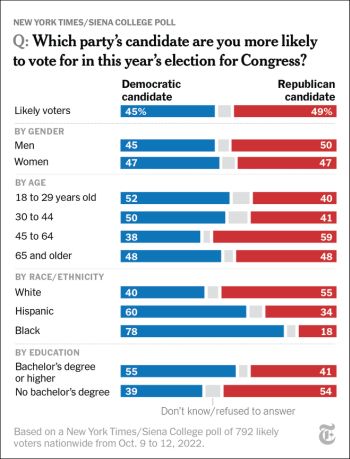
Razor thin: An October New York Times/Siena College poll suggested the national midterms are neck-and-neck.
Democrat candidates don’t want to tie themselves too closely to President Joe Biden – not only are midterm elections so often referendums on the party in power, but the president’s underwhelming approval ratings don’t bring much optimism.
Under normal circumstances, Republican candidates – during a midterm in which their party holds none of the three branches – would love to leverage the GOP establishment and constantly allude to D.C. disarray. But with the party mainstream still inextricably linked to Trump, who is increasingly unpopular and in increasing legal jeopardy, that might not help.
There is a silver lining to all this: I’ll take my political candidates focusing on the issues that matter to my community – over engaging in typical Washington warfare – any day of the week. This is really what they should be doing always.
In this way, the race for the New York Third Congressional District is really a microcosm for the 2022 midterms as a whole. It’s a race between two anti-establishment candidates – neither has held elected office – contested in a politically moderate district and focused primarily on community-level issues.
Both candidates are threading the needle of convincing voters they’re ready to operate within the mechanisms of Washington while also serving as agents of change. Which of them gets the chance depends on how the nationwide elections break – a bellwether of change from past midterm elections, or another year when the noise in Washington drowned out local candidates’ individual messages.
David A. Chauvin is executive vice president of ZE Creative Communications.