By GREGORY ZELLER //
From the Department of Multitasking comes energy-savings innovator Energia, which is perfectly happy to save the world, but sees no need to stop there.
 Launched in 1998, Smithtown-based Energia (formerly ECG Group) is an energy advocate and consultant for local school districts, focused primarily on introducing new clean-gen and sustainability technologies to cash-strapped schools.
Essentially, the company serves as a much-needed middleman between schools and manufacturers – sparing school administrators the tedium of technology research, the pain of private-contract negotiations and the hassle of project management, while ensuring maximum energy and cost savings in each project.
Now in the capable hands of second-generation CEO Kendra McQuilton, Energia has completed 130-plus school district energy-savings projects, producing more than $1 billion in “energy savings improvements” for clients in New York, Connecticut, Massachusetts and elsewhere.
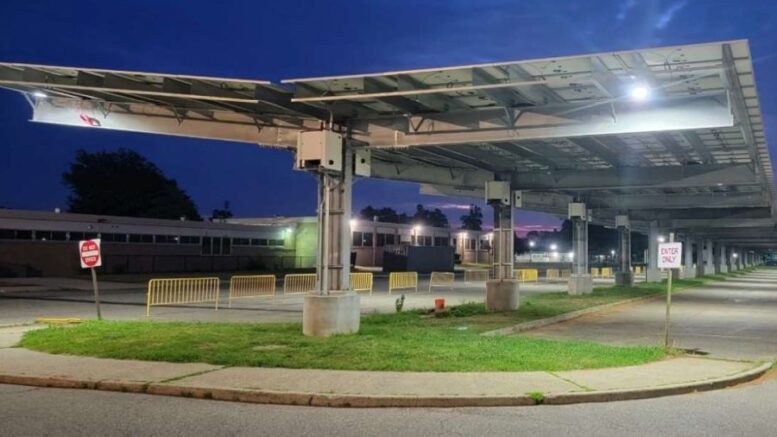
McQuilton – who took the reins in 2016 from her father, founder George Lawrence, and oversaw a bold 2022 rebranding – is now zeroing in on a unique vertical: solar carports, which place photovoltaic solar cells on canopies over parking areas, capable of generating enough juice to light the lots and much more.

Kendra McQuilton: Beyond energy savings.
Solar carports are not necessarily unique for their ability to farm solar-generated electricity, but they do “bring several more benefits than renewable energy,” according to the CEO, who has wheeled deals to create carports for seven Long Island school districts, and counting.
Energia has completed solar-carport projects for the Commack and Westbury union-free school districts (where the systems are already online) and for the Middle Country Central School District (where two completed canopies await final utility approvals). Additional systems are under construction in the Kings Park CSD, the Plainedge UFSD and the Eastport-South Manor CSD, with three solar carports for the Roosevelt UFSD in the design stage.
The carports are different sizes, depending on the physical spaces being canopied. Some districts have engaged one-off projects (Westbury High School’s new canopy cranks out 803 kilowatts of electricity), while some have contracted for multiple constructions (Middle Country’s two new canopies will produce a combined 1.12 megawatts of electricity, while Eastport-South Manor’s four canopies will surpass 2.6 megawatts, according to Energia).
But regardless of its size, each project promises considerable cost savings. The Westbury UFSD can expect an annual energy savings of $128,876 from that one canopy; in Kings Park, where Energia is installing a solar walkway canopy instead of a solar carport, annual savings should exceed $10,000.
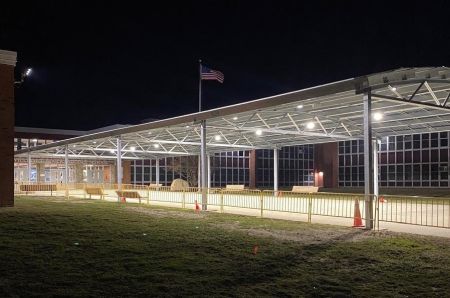
Dry run: Instead of protecting a parking lot, the solar canopy installed at Kings Park’s William T. Rogers Middle School shields students and staff on rainy days.
Meanwhile, the planning-stage Roosevelt systems – three separate carports – are projected to generate more than $372,000 in yearly savings.
Generating clean energy while significantly cutting costs is already a worthy win-win – but the individual installations create further innovation opportunities, according to McQuilton, who trumpets some clever design work with that Kings Park canopy.
“What’s cool about Kings Park is the canopy leads up to the (William T. Rogers Middle School) main entrance,” the CEO noted. “Everyone was getting soaked when there was bad weather, walking from the buses to the main entrance, which is kind of far.
“The superintendent asked if we could help,” McQuilton added. “So, we custom-designed a system to meet their specific needs.
“This is a solution that went beyond energy savings.”

David Newman: Attractive offer.
With the solar-carport vertical off and running, Energia is expecting things to take off from here. David Newman, the Smithtown innovator’s vice president of engineering, referenced the 2022 passage of the Inflation Reduction Act as an especially promising development.
“The IRA includes massive provisions intended to reduce the manufacturing and distribution costs of renewable technologies such as solar, which will help make the technology even more attractive for customers,” Newman noted. “We expect the amount of [solar] installations to continue or even accelerate moving forward.”
With the Inflation Reduction Act also extending and expanding investment tax credits for renewables – an enormous incentive to public entities like schools – McQuilton agrees that solar carports will find more homes in Long Island school parking lots.
Especially, the CEO told Innovate Long Island, with so many factors conspiring to make New York “a hotbed for solar-renewable technologies.”
“New York’s energy rates are so high, it reduces the time for the return on investment for solar-renewable technologies,” McQuilton said. “The higher the rate, the quicker it pays for itself.
“Along with incentives from utilities and technology improvements, those high rates make it a very sound financial decision for most school districts to at least explore the potential of these types of systems,” she added. “And we’ve generated a tremendous amount of expertise in this area.”