
By SEYMOUR LIEBMAN //
While innovation is always the driving force behind advancement, patents – known best for helping to protect innovation – often get a bad rap, as nothing more than legal speed bumps on the road to progress.
 But let’s not judge a patent by its paperwork. Contrary to popular belief, these seemingly mundane documents are the secret sauce fueling the innovation engine.
A U.S. patent provides the owner exclusive rights to the defined invention, enabling the patent owner to exclude others from making, using, selling, offering for sale or
importing into the United States any patented invention, without authority, for the patent’s term – typically 20 years from the date the initial patent application is filed.
In 2023, Canon ranked fifth for the number of U.S. patents awarded, becoming the only company in the world to rank in the top five for 38 consecutive years. While there are myths that big corporations with extensive resources are the only beneficiaries of patents, this couldn’t be further from the truth.

Seymour Liebman: Paramount protections.
Patents level the playing field by giving inventors and innovators of all sizes a competitive opportunity to own and protect their inventions or intellectual property. But protecting IP is only the surface-level benefit.
Patents drive innovation – incentivizing investment in research and development, fostering a culture of creativity for both inventors and competitors and otherwise advancing markets. They encourage innovators to outdo competitors, and their required disclosures often provide a stimulus for the next big innovation.
In today’s hypercompetitive landscape, where technological disruption is the norm rather than the exception, the ability to innovate and protect IP rights is paramount. Patents offer significant protections against imitation – a fortress against this fear, providing essential reassurances that inventions are shielded from unauthorized replication.
Legally enforceable exclusivity is the bedrock of patent protection. Patent infringement is a serious civil offense and patents offer the necessary protections to facilitate innovation.
On a more positive note, acquiring a patent bestows upon inventors a newfound market leverage, propelling them into positions of dominance within their respective industries. Beyond merely safeguarding their creations, patents empower inventors to dictate the pace of affairs, increasing market share and profit margins in the process.
Canon has long leveraged patents to stay ahead of the competition, anticipating new technologies and businesses to come.
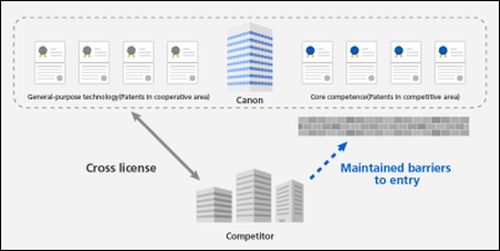
Open and shut case: Canon straddles the line between “open” and “closed” patent systems. (Source: Canon USA)
Canon’s patent strategy to is known as an “open and closed” strategy. Patents on Canon’s core competencies – which are the outcome of research and development in the company’s main business fields – are typically not licensed but are utilized to secure Canon’s competitive advantage.
Patents on general-purpose technologies – communication technologies, user-interface technologies, etc. – are typically used for cross-licensing (licensing Canon’s patents to another entity in exchange for license to use the other entity’s patented technologies).
This IP strategy has helped Canon invest in research and development to push the boundaries of technological progress and create new values for the world. This has enabled Canon to consistently stay ahead of many competitors over the years. It’s the company’s firm belief that one of the key elements of success in innovation-based business is patents.
Canon’s relentless pursuit of excellence is not merely a pursuit of profit; it’s a commitment to harness the power of creativity and ingenuity to address pressing societal challenges and drive positive change to realize the betterment of society and the preservation of our planet.
 In 2020, Canon announced an Intellectual Property Open Access Declaration Against COVID-19 with other companies and universities. This declaration stated that participating entities would not enforce their IP rights against any development or activity meant to stop the spread of COVID-19 until the public health emergency was over.
Canon is also a partner in WIPO GREEN, a platform run by the World Intellectual Property Organization designed to promote the use of environmentally friendly technologies. In cooperation with WIPO, Canon contributes to the implementation of various green tech – right in line with Canon’s corporate philosophy of kyosei, a Japanese term embodying the concept of living and working together for the common good.
As we look toward the future, Canon remains committed to pushing the boundaries of all the technologies the company is involved with and driving progress across all facets of the company’s business. Through strategic acquisition and utilization of IP rights, Canon continues to reinforce its business, offer added value to its customers and the world as a whole and contribute to a future where innovation knows no bounds.
Seymour Liebman is executive vice president, chief administrative officer and general counsel for Melville-based Canon USA.