
By TERRY LYNAM //
Except for abortion, healthcare has largely been a back-burner issue for most of the 2024 presidential campaign.
 The only time it came up during the Sept. 10 Harris-Trump debate was when a moderator questioned the candidates about the Affordable Care Act, with Trump saying he had “concepts of a plan” to replace the ACA (aka “Obamacare”) but provided no details.
Within days, his running mate, U.S. Sen. JD Vance (R-Ohio), attempting to fill in the blanks during television and campaign appearances, ignited a firestorm when he proposed deregulating the health insurance markets “so that people can choose a healthcare plan that fits them.”
Among its hallmarks, the ACA requires insurers to cover people with pre-existing conditions without charging higher premiums. Instead of this “one-size-fits-all” mandate – which lumps all recipients into a single risk pool – Vance floated the idea of restructuring health plans so chronically ill people are placed in a high-risk pool, separate from younger, healthier customers.
His comments have drawn swift reaction from both the left and the right. While creating separate risk pools would likely lower premiums for healthier patients, Democrats and patient advocates say cancer patients and others with serious medical conditions would see their premiums jump – with higher out-of-pocket costs, caps on covered services and other benefit limits almost certain.
During the Oct. 1 vice presidential debate, Vance dismissed those concerns.

Terry Lynam: Challenging times.
“We have current laws and regulations to protect people with pre-existing conditions and want to keep the regulations in place and help the insurance marketplace function a little better,” he said.
Conservatives are applauding Vance’s ideas, citing the need to promote choice and rein in the massive government subsidies that keep the ACA afloat (federal subsidies for non-group insurance marketplaces established under the ACA are projected to exceed $1 trillion over the next 10 years).
Bottom line: With the Presidential and Congressional elections looming, Republicans are subtly rekindling efforts to sabotage Obamacare.
The GOP was within one vote of repealing some of the ACA’s most significant regulations in 2017, when the late U.S. Sen. John McCain (R-Arizona) – suffering from brain cancer at the time – defied his party’s leaders and cast the decisive “no” vote against the legislation (the final Senate tally was 51-49).
The ACA survived another challenge in 2020, when the U.S. Supreme Court rejected efforts by the Trump administration and more than a dozen Republican-led states to overturn the law.
For her part, Vice President Kamala Harris has vowed to strengthen the ACA, abandoning previous positions in which she supported moving toward a single government-run insurance system. As a U.S. senator in 2019, she cosponsored Sen. Bernie Sanders’ (I-Vermont) “Medicare for All” bill – and later that year, as a contender for the 2020 Democratic presidential nomination, released a healthcare plan to pursue a government-backed health-insurance system over 10 years without entirely eliminating private health insurance.
Since then, Harris has backtracked, recognizing the public’s reluctance to embrace a government-run health system for everyone.
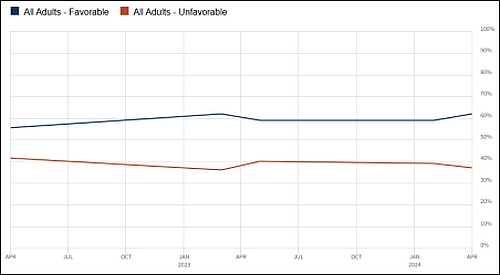
Risky business: Republicans are challenging a national healthcare law that has only increased in popularity over the last several years. (Source: Kaiser Family Foundation)
Politically, Republicans’ efforts to chip away at the ACA would seem risky. Since the law was fully implemented in 2014, nearly 50 million Americans have enrolled in the federally funded health-insurance markets, reaching an all-time high of 20.8 million this year. In New York, more than 1.7 million people are enrolled, including more than 246,000 Long Islanders (130,166 in Suffolk County and 116,138 in Nassau County).
Nationally, the number of uninsured has been nearly cut in half (from 48 million in 2010, when President Barack Obama signed the ACA into law, to 25 million in 2023). And while Americans’ views of Obamacare have fluctuated over the years, recent polling shows it’s now viewed favorably by 62 percent of those surveyed – numbers that spiked upward during the Trump administration.
Despite the ACA’s popularity, federal subsidies that help 20 million Americans pay for health insurance on the Obamacare marketplaces are set to expire at the end of 2025. The enhanced tax credits, which were passed as a temporary measure during the COVID pandemic as part of 2021’s American Rescue Plan (then extended as part of the Inflation Reduction Act in 2022), increased subsidies for individuals earning between 100 and 400 percent of the federal poverty level and expanded eligibility for those earning more than 400 percent.
Without the subsidies, an estimated 3 million Americans could lose their health insurance entirely and nearly 9 million people would pay more for coverage – roughly $406 per person – according to Democratic sponsors of a bill to make the tax credits permanent.
Pointing to Congressional Budget Office estimates that extending the ACA subsidies would cost taxpayers $383 billion and increase the nation’s budget deficit by $335 billion over the next 10 years, Republican budget hawks are digging in for another fight, complaining that too many of those benefiting are higher-income individuals who should be paying for insurance out of their own pockets.
It’s clear that Obamacare remains in the GOP’s crosshairs, 14 years after its passage. It will likely survive beyond next year, but the outcome of the November elections could bring major changes.
Terry Lynam is a communications consultant and former senior vice president/chief public relations officer for Northwell Health.