
By JEFFREY L. REYNOLDS //
The rules are clear: Charitable organizations are supposed to stay out of politics.
 An important provision in Section 501(c)3 of the Federal Tax Code – often referred to as the Johnson Amendment – requires that, in exchange for tax exemptions, charitable nonprofits, foundations and religious organizations may not “participate in, or intervene in (including the publishing or distributing of statements), any political campaign on behalf of (or in opposition to) any candidate for public office.”
That’s fair. And it’s probably a blessing, especially during raucous campaign seasons like the one we’re enduring now.
But a federal lawsuit filed against the Internal Revenue Service in August by two Texas churches and two advocacy groups alleges that the 70-year-old nonpartisanship provision violates the First Amendment, because it prevents churches and other charitable nonprofits from speaking out on partisan political matters.
It also violates the Fifth Amendment, according to the lawsuit, because it’s “unevenly” enforced by the IRS.
The National Council of Nonprofits called the litigation “misguided,” noting it “contributes to the further politicization of the charitable sector and society.” The Washington-based trade group has opposed several recent policy efforts to allow nonprofits to engage in partisan activities, up to and including endorsing political candidates.

Jeffrey Reynolds: Keep politics out of human services.
In 2017, President Donald Trump issued an executive order that attempted to weaken the Johnson Amendment. And a provision proposed in the 2017 federal tax bill would have allowed charitable nonprofits to endorse candidates for public office when communicating “in the ordinary course of the organization’s regular and customary activities” – but it was axed at the last minute on a technicality.
The Free Speech Fairness Act, introduced perennially by Rep. Steve Scalice (R-LA), contains the same provisions and would, for example, allow college presidents to email alumni on behalf of a candidate, enable hospital executives to put campaign signs in emergency rooms and allow preachers to deliver electioneering Sunday sermons, thereby distributing low-cost messages that would satisfy the de minimis spending language in the proposed legislation.
Under current law, charitable nonprofits, including religious congregations, remain free to weigh in on issues impacting their constituencies and can advocate on public-policy issues and proposed legislation. They can still testify before legislative bodies, issue position papers, write letters to lawmakers, rally, demonstrate and mobilize communities.
In fact, they should.
They can also engage in nonpartisan political activities like hosting candidate forums, distributing candidate questionnaires and transporting voters to the polls. Bethpage-based Family Residences and Essential Enterprises recently hosted voter registration and education workshops for consumers with intellectual/development disabilities and mental illnesses, as did EPIC Long Island, who partnered with the League of Women Voters on theirs.
The Boys and Girls Club of the Bellport Area, meanwhile, works with the local chapter of Zeta Phi Beta – an historically African American sorority – to provide voter education to youth and their families.
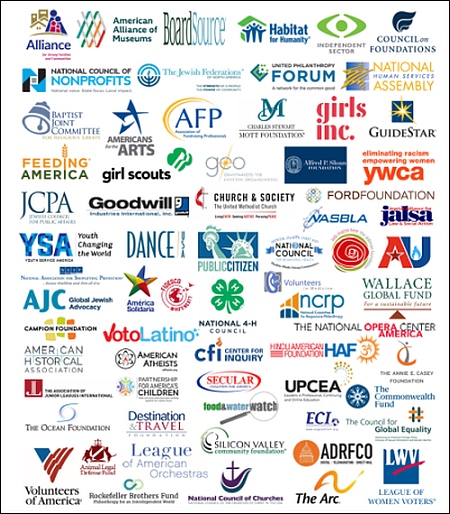
Strength in numbers: The coalition opposed to repealing the Johnson Amendment is comprehensive and formidable. (Source: National Council of Nonprofits)
Critics correctly argue that repealing the Johnson Amendment would blow a hole in the federal budget because tax filers could claim charitable deductions for political contributions funneled through nonprofits – and that the move would undercut fair elections by providing a loophole to avoid campaign-contribution disclosure laws.
We’d also probably see candidates, political operatives and their donors exert immense pressure on nonprofits, foundations and houses of worship. Quid pro quo would become the norm.
Nonprofit board meetings would become circuses where major donors and trustees with contrary views argue about candidate endorsements instead of focusing on the organization’s mission and management. Public trust in the nonprofit sector would suffer.
Whether focused on arts and culture, education, the environment, healthcare, human services, sports, business development or animal welfare, nonprofits are safe havens where dedicated, passionate people come together to solve community problems – problems that are left unaddressed by government and even sometimes exacerbated by politics.
Nonprofit staff and volunteers feed, shelter, protect, educate, heal, inspire and nurture neighbors of every age, gender, race, socioeconomic status and political persuasion – while fostering civic engagement, driving economic growth and strengthening communities.
So, the next time a political candidate ambushes you outside a bagel shop or on a crowded train platform with a bumper sticker or pamphlet asking for your vote, ask how he or she will keep local nonprofits strong, independent and above the political fray. Remind them that nonprofits are small businesses that employ their neighbors while delivering programs that save taxpayers money and save lives.
Ask them how they plan to invest in the nonprofit sector and find out how they will involve charitable staff, volunteers and the communities they serve in policy-making.
Finally, ask if they’ve interacted with local nonprofits as a donor, volunteer, community partner or beneficiary. And if they haven’t, end the conversation with a suggestion they do – regardless of the outcome of their race.
Jeffrey Reynolds is the president and CEO of the Garden City-based Family and Children’s Association.