Is it over? Not quite, dear readers – but the voting is done, there’s a hard stop on those miserable campaign commercials and the endless election signs blockin’ out the scenery … one day, like a miracle, they will disappear. So, there’s that.
Welcome to Wednesday, very much The Day After. Sincerest congratulations to the 150 million-or-so Americans who exercised their right to vote this year, many under challenging conditions that ranged from unfortunate to despicable.
Record voter turnout is a commendable act of democracy for an America in desperate need of shining examples. But if this election is ultimately decided in the courts, and not at the polls, record disenfranchisement will follow.
Stay calm, stay informed and stay tuned. For now, at least, the republic stands – so let’s innovate.

Prime example: Prime Minister Narendra Modi celebrates a big win in India’s enormous 2019 general election.
Turns out: Unprecedented here in the States and absolutely worthy of another round of applause, our impressive voter turnout was nowhere near history’s biggest democratic exercise.
Also had a good turnout: Though the gross numbers were slightly lower on Nov. 4, 1845, the first time U.S. voters had only one day – the first Tuesday in November – to pick a president.
The natural: Still chronicling universal sciences (as humans understand them), the peer-reviewed journal Nature was first published in England on this date in 1869.

Registered: The cash register was patented 141 years ago today.
Ka-ching: Ohio saloon owner James Ritty patented the cash register, which he designed to keep his bartenders honest, on Nov. 4, 1879.
Subsequently used, on occasion, to empty cash registers, the machine gun was patented on this date in 1862 by inventor Richard Gatling.
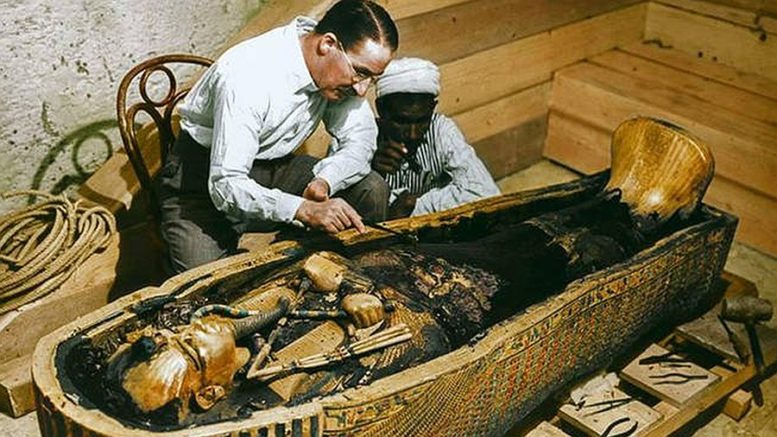
Walk like an Egyptian: The entrance to King Tutankhamen’s ancient tomb was discovered in Egypt by famed archeologist Howard Carter on Nov. 4, 1922.
In retrospect, some wish he hadn’t found it.
Now UNESCO: And following ratification by the United States and 19 other nations, the United Nations Educational, Scientific and Cultural Organization Constitution became international law on this date in 1946.

Cronkite: Straight shooter.
That’s the way it is: American broadcast journalist Walter Leland Cronkite Jr. (1916-2009), 19-year rock of the “CBS Evening News” and eternal bastion of journalistic integrity, would be 104 years old today.
Also born on Nov. 4 were American rubber baron Benjamin Franklin Goodrich (1841-1888); American humorist Will Rogers (1879-1935); Scottish philosopher and theoretical physicist Lancelot Law Whyte (1896-1972), a science historian and prolific science writer; Indian numerologist and astrologer Shakuntala Devi (1929-2013), the legendary “human computer”; and Long Island’s favorite karate kid, Ralph George Macchio Jr. (born 1961).
Stick it in your ears: And take a bow, Anne Marie Sweeney! The nine-time Hollywood’s Most Powerful Woman – a former co-chairwoman of Disney Media, president of the Disney-ABC Television Group and president of the Disney Channel, who quit the Mouse House in 2014 to direct TV shows (and now sits on the boards of Netflix and Lego) – turns 63 today.
Wish the trailblazing executive and all the other Nov. 4 innovators well at editor@innovateli.com, and if you could direct us toward some interesting stories and calendar events, we’d be much obliged.
 About our sponsor: Nixon Peabody is an international law firm with an office in Jericho that works with clients who are building the technologies and industries of the future. We have the experience necessary to drive your business forward and help you negotiate risks and opportunities related to all areas of business and the law, including startup work, private placements, venture capital and private equity, IP and licensing, labor and immigration and mergers and acquisitions.
BUT FIRST, THIS
Bracing for the worst: With ugly Election 2020 playing out in such brutal fashion, Stony Brook University has taken several proactive steps to safeguard the mental health of its myriad community members – and is ready to deal with negative election fallout.
Stony Brook’s Healthier U initiative has already provided university staffers with meditative activities, labyrinth walks and other personal and group offerings designed to address spiking election-related anxieties. University students, meanwhile, have benefitted from peer-counseling efforts, while SBU also developed a community-focused webpage designed to promote civility and mutual respect across the campus, even as some political leaders turned up the hurtful and divisive rhetoric.
The campaign is mercifully over, but the focus on the emotional wellbeing of community members will continue – a prime example of the Stony Brook University culture, according to Interim Associate Dean of Students Jeff Barnett. “We take care of each other,” Barnett said. “We look out for each other. That’s a community.”

Hayward: Nucleic acid trip.
Frequently Applied: These are busy days for Applied DNA Sciences, which cut its teeth as a supply-chain authenticator but has established itself as a leader in polymerase chain reaction-based DNA manufacturing.
The Stony Brook-based biotech announced this week that its one-of-a-kind DNA strands, produced large-scale by the company’s proprietary LinearDNA platform, will be part of new RNA vaccine and Adeno-Associated Virus production efforts by two separate contract-research companies. In August, Applied DNA announced a new application to patent its method of manufacturing AAV products via the LinearDNA platform.
The biotech has also received a follow-on linear DNA order from an existing customer focused on preclinical CAR T cell therapy, the third order from that particular customer for the company’s unique DNA strands. “Our LinearDNA manufacturing platform is paving a new path for nucleic acid-based drug development,” Applied DNA Sciences President and CEO James Hayward said Monday. “We believe this makes us applicable to every preclinical or clinical nucleic acid-based drug-production program being pursued by the industry’s leading companies.”
TOP OF THE SITE
Absentee present: The “Vote North” initiative helped inpatients across the Northwell Health system obtain and file absentee ballots before Tuesday’s deadline.
When scientists collide: Stony Brook University and Brookhaven National Laboratory scientists have significantly upgraded CERN’s Large Hadron Collider.
Innovation in the Age of Coronavirus: Albany alters advisories, Fitbit friends Feinstein and salon snafus savaged – alliteration abounds in LI’s one-and-only pandemic primer.
VOICES
However and whenever the pandemic ends, regional and national land-use laws will never be the same – fortunately, legal eagle Michael Sahn sees the chaos coming, and knows what to do.
STUFF WE’RE READING
Startup engine: European policymakers are uniting to position Euro Tech as a rival for Silicon Valley talent (and investments). Sifted surveys.
A marathon, not a sprint: With COVID surging, the national economic recovery will take longer than many had hoped. The Brookings Institution runs it down.
Strong to the finish: Scientists are using Popeye’s favorite performance enhancer to power batteries and more. Design News eats all its spinach.
RECENT FUNDINGS
 + Erbi Biosystems, a Massachusetts-based instrumentation company based on an MIT-developed microfluidic bioprocess, closed a $3.8 million funding round led by Jaguar Biotech.
+ Teampay, a New York City-based distributed-spend management platform, raised $5 million in a Series A-1 extension led by new investor Fin Venture Capital, with participation from existing investors Tribe, Crosscut and Precursor.
+ Arable, a California-based provider of agricultural data solutions, closed a $20 million Series B funding round led by Prelude Ventures, with participation from M2O, AVG’s Nassau Street Ventures, Tridon, S2G Ventures, Middleland Capital, Ajax Strategies and Chase Field.
+ Be Biopharma, a Massachusetts-based biopharma developing medicinal B cells, raised $52 million in Series A financing led by Atlas Venture and RA Capital Management, joined by Alta Partners, Longwood Fund and Takeda Ventures.
+ Momi Brands, a North Carolina-based manufacturer of a breast pump/infant-feeding system, closed a $1 million seed funding round led by Kapstone Medical and Enventys Partners, with participation from the Start100 Fund.
+ Stairwell, a California-based cybersecurity company, raised $4.5 million in seed funding led by Accel, with participation from Sequoia Capital, Gradient Ventures, Allen & Co. LLC and other angel investors.
BELOW THE FOLD

Oh, synapse: Science has decoded nerd brains.
Ex machina: Sorry, automatons, but Walmart is powering down its inventory bots.
Pro machina: After a colossal 2020, digital health is just powering up.
Nerds, explained: Why sex and money don’t interest you, but learning and nuance do.
Machine thinking, human ingenuity: Please continue supporting the amazing firms that support Innovate LI, including Nixon Peabody, where e-alerts, virtual events and engaging blogs keep clients updated on the latest trends and industry developments. Check them out.