
By KATE FULLAM //
Ice … great for skating and sipping, but a bit problematic for getting around.
 Unfortunately, far too many friends have suffered broken wrists and fractured ankles in slip-and-fall accidents this season. Throw in a global plague, and it really makes you want to stay home.
But in between snowstorms this week, there was a peek of sunlight – and I jumped at the chance to take a brisk walk at the Quogue Wildlife Refuge. It was cold, but who knew I’d be getting a lesson in early refrigeration?
The Fairy Dell Boardwalk in Quogue provides a lovely history of ice harvesting in the area, and a quick walk across the street to the Refuge property yields even more tales, in the form of an ice-harvesting exhibit located inside an original icehouse from Quantuck Creek (“dismantled and erected at the Refuge site in 1914,” according to “A History of the Quogue Wildlife Refuge,” by Carl Helms).
Any food producer or restaurant owner knows the stress associated with refrigeration. Issues usually crop up when you least expect them, and when you most need your walk-in freezer to be working at topnotch levels.

Kate Fullam: Ice queen.
Now, can you imagine the logistics involved in manually harvesting, storing and distributing 125-pound ice blocks? Tough sledding, as they say, but absolutely necessary if you wanted to preserve your food back in the day.
Educational signage at the Refuge revealed that, as the summer population increased on the East End at the turn of the 20th century, the Quogue Ice Company was formed to satiate a greater demand for cold-food storage. But the ice industry began much earlier than that, in 1805, thanks to Frederick Tudor of Boston.
Tudor was known as the “Ice King” and was among the first to market ice for enjoyment of cool drinks in the summer months. According to the story, his first and second shipments were destroyed by heat, but he never gave up; Tudor developed better methods for storage and transportation, and by 1909, there were nearly 2,000 commercial ice plants across the nation.
The exhibit also points out what remains a logistical problem for our modern food system: “As cities began to grow, so did the distance between consumers and their food source. With the use of ice-refrigerated train cars, perishable items could be distributed to further locations; and through the use of sea vessels, foods from one side of the world could be shipped to the other with minimal spoilage.”
Another curious historical parallel to the events of today can be found with the arrival of the COVID pandemic. In examining this history, it occurred to me the arrival of the 1918 influenza pandemic was just after cold shipping became commonplace.
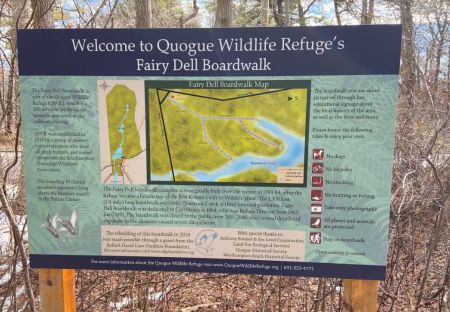
Park place: The skinny on the Fairy Dell Boardwalk.
In fact, NPR’s “Morning Edition” reported recently on a World Health Organization investigation into the origin of the COVID-19 pandemic in China, which speculated on the potential transmission of the virus through large pallets of frozen meat and seafood in bulk.
Turns out this isn’t a major concern – one NPR source, a Rutgers University microbiologist, said the China cases were in “a specific environment, and one very different from those a regular consumer would be in.”
So, it seems the frozen food aisle poses no threat, though history suggests that eating food grown or made closer to home is better for our communities, our bodies and our planet.
Icy sidewalks and roads, meanwhile, they’re definitely a threat. Fortunately, to eat well around here, you don’t have to go very far – Long Island producers offer consumers a true bounty, fresh or frozen, all year long!
Kate Fullam is executive director of the East End Food Institute.