By TOM MARINER //
As I stepped from the airplane directly onto the runway, I remember thinking that the door sill was eight feet higher when I boarded.
 A silver-suited crew scurried around the plane, spraying white foam from hoses, as I joined the silent line of passengers lining the edge of the tarmac. We’d come to rest at the intersection of two runways, which were quiet – our wild spin along the landing strip had quickly shut down the whole airport.
It was a bizarre sight, for sure: the fire team, the winter-garbed passengers, the single airplane wing pointing skyward. Soon we were herded onto buses that would take us to the terminal at Rhode Island’s T.F. Green International Airport – not the terminal at Boston Logan International Airport, where I was supposed to be – and our interviews with FAA officials.
It had been quite an adventure: The pilots announcing that one landing-gear wheel had jammed, the close control-tower flyby to confirm it, the final approach with television cameras and crowds at the end of the runway, the flight attendants shouting commands, the passengers bracing our heads and arms against the seats in front of us, ready for impact.

Tom Mariner: Speed racer, by land or air.
We emerged without a scratch, but my adventure was just beginning. How was I going to get to my project meeting in Chelmsford, Mass., with The Whistler Group?
Flash back four months, when I’d gotten a call at Mariner Associates – a small company I’d formed with some old colleagues from Hicksville’s General Instrument Microelectronics – from Dave Truesdell, the vice president of engineering at Whistler, a leader in automobile radar detectors. Their largest-selling unit, programmed by a South Korean firm, was getting false alarms from certain television frequencies, according to Truesdell, and the Korean firm had run out of programming room in the microcontroller produced by General Instrument. The Koreans wanted big bucks to redesign the unit.
The microcontrollers of the day – this was sometime in the early 1990s – were 1,000 times smaller than today’s versions, putting a premium on efficient, innovative programming and design.
Because the Korean firm was pitching the redesign and looking to build the units, they wanted to make Whistler a marketing channel for their creation – supersizing their previous technical fees and reducing the Massachusetts firm to a tiny sales commission.
Adding to Whistler’s pressure, the company was in the midst of closing a deal with Walmart for a large quantity of the units.
Dave heard that my firm, among other things, designed automobile electronic products – and was magic at squeezing a lot of intelligence into tiny computers. They wanted to fix the problem quickly, he said, without a technical or financial disaster.
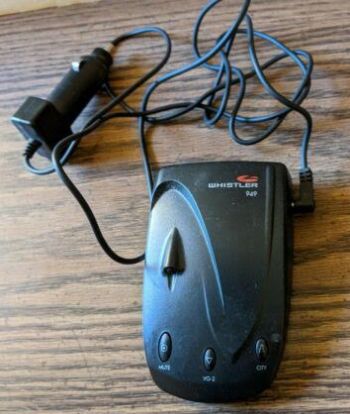
On the radar: A vintage Whistler detector, featuring Mariner’s guts.
I flew regularly from Long Island to Whistler’s Massachusetts plant for design reviews. Then came the exciting landing in Providence, and I decided that driving to the Massachusetts plant from Long Island wouldn’t take much longer than flying. This suited my frazzled nerves just fine.
Ultimately, we managed to “shrink the code,” correct the TV-jamming issue and even add features to catch new frequencies the traffic police were using in their radar guns. The new prototype worked well.
But during one four-hour drive, I mounted another product, an Escort Radar Detector, instead of my prototype, just to test out the competition. Rounding a long, blind bend where Route 90 meets Route 495, the Escort lit up – way too late, since I was already on top of a group of squad cars. The cop who pulled me over grinned at the detector on my dashboard and happily wrote me a ticket.
Inside the Whistler plant, I noted some very ornate, very tall, obviously expensive black urns and a beautiful, decorated screen, all waiting in the lobby. When I asked about them, a manufacturing executive chuckled and said, “Oh, those are yours.”
Turns out the Korean engineers, after we had proven able to overcome the technical glitches without them, backed off their lofty demands – and even had their top managers visit Whistler to beg forgiveness, bearing gifts.
The gifts became my own little “reshoring” reward, making the flying follies and the annoying ticket well worth it.
Tom Mariner is the chief operating officer of Stony Brook-based SynchroPET and the founder of Bayport-based Kommercialization LLC.