By DAVID A. CHAUVIN //
Earlier this week, the Merriam-Webster Dictionary announced that the word “authentic” was the 2023 word of the year – defined as “true to one’s own personality, spirit or character,” and a fascinating way to summarize and critique 2023.
 After all, 2023 brought us ChatGPT and mainstreamed the questioning of reality. However, it seems the more we questioned authenticity, the more we craved it. No wonder it was among the most-looked-up words of the year.
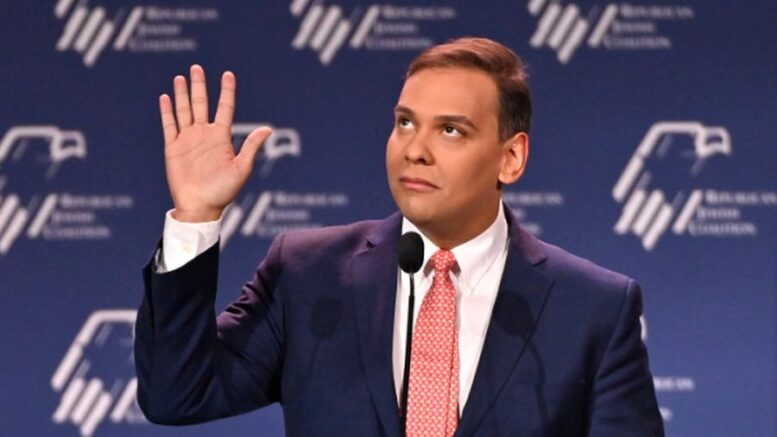
As the world grappled with the erosion of authenticity, particularly in the digital realm, the political sphere witnessed a parallel disintegration. The case of Long Island Congressman George Santos exemplifies this, symbolizing the severe disconnect between political representation and reality.
In response, political candidates across Long Island, sensing the public’s growing disdain for inauthenticity, have hastily adjusted their strategies. Brands and marketers are also taking note of this reality-questioning as we head into 2024.
This dilemma mirrors the public’s turn toward platforms like BeReal, where they seek refuge from the filters rampant on conventional social media. It was also clear from this year’s election results that Long Island voters, regardless of party affiliation, demand truth – authenticity was the central theme of many winning campaigns.
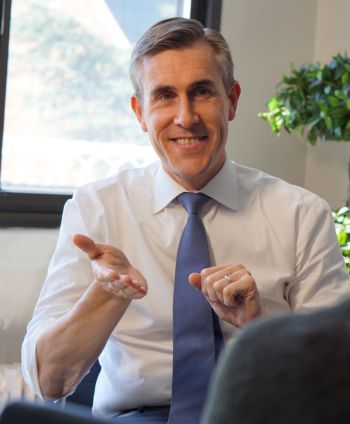
David Chauvin: As real as it gets.
Whenever I think about the need for a candidate to be a “real, relatable person,” I think back on an episode of “The West Wing” in which President Bartlett (played by Martin Sheen) tells an auditorium filled with college students that his staff was debating whether he should wear a suit jacket or not, because of the message it would send either way. Ultimately, he removes the jacket because it’s hot under the bright stage lights and asks the audience if they’d mind not caring.
Aaron Sorkin’s scripts don’t always reflect reality, but this was an incredibly human moment that helped the fictional president connect with the audience – specifically by straying from the strategic manipulations that are all too common in political campaigning.
Pretty much the opposite of what Vivek Ramaswami is doing on the Republican presidential debate stage.
On Long Island, voters – cutting across party lines – seemed to prioritize truthfulness this year, making authenticity a cornerstone of successful campaigns. Newly elected Suffolk County Executive Ed Romaine echoed this idealistic view of what a political campaign could be; rather than relying on slick marketing or scripted soundbites that stoked fears or hyped up national-political hyperbole, his appeal lied in his genuine connection with the people he serves and his track record as the Town of Brookhaven supervisor.
Romaine’s unfiltered conversations with constituents, addressing their hyper-local concerns head-on, proved to be the winning strategy. Though I backed his competitor, Romaine’s success signals a departure from the era of polished politicians and a return to the roots of public service.
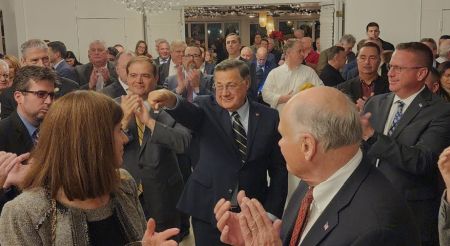
Honest Ed: Suffolk County Executive-elect Edward Romaine (center) eschewed rhetoric and connected with constituents on real issues.
Meanwhile, in the Town of Hempstead, Don Clavin stood as the incumbent supervisor, a beacon of authenticity in a sea of political posturing. Clavin’s re-election approach was as straightforward as his constituents expected: He eschewed grandiose promises, opting instead for a transparent display of his accomplishments.
From revitalizing local infrastructure to championing community initiatives, Clavin’s authenticity lies in the tangible results he delivered. In the realm of political campaigns, where smoke and mirrors often reign supreme, Clavin stood out like a lighthouse, guiding voters through the fog of political rhetoric.
Then there’s newly elected Suffolk County Legislator Rebecca Sanin, a refreshing newcomer who formerly served as the CEO of the Health and Welfare Council of Long Island. Her campaign wasn’t just about winning votes; it was about forging a genuine connection with the community.
Sanin leveraged her background as a health advocate, bringing a unique perspective to the political stage. Her authenticity wasn’t a façade – it was ingrained in her advocacy for accessible healthcare, transparent governance and community wellbeing. In an era in which voters crave sincerity, Sanin’s authentic approach proved to be a winning formula.
These examples are a far cry from the “all politics are national” trend that has plagued local governments throughout the country over the past handful of years.
Hopefully, George Santos’ deceit will serve as a turning point. While the Santos saga serves as a stark warning about the consequences of betraying public trust, rewards await those who embrace authenticity.
In a political landscape rife with cynicism and skepticism, authenticity emerges as the panacea – a powerful antidote that not only wins elections, but also fosters a healthier and more robust democracy.
David A. Chauvin is executive vice president of ZE Creative Communications.