By DAVID A. CHAUVIN //
Thirty years ago – on June 17, 1994 – came the wildest day in the history of sports media.
 The New York Rangers had just won the Stanley Cup, and New York City celebrated with a traditional tickertape parade down Lower Manhattan’s Canyon of Heroes. The New York Knicks battled the Houston Rockets in Game 5 of the NBA Championship. President Bill Clinton and Oprah Winfrey presided over the opening ceremony of the 1994 FIFA World Cup, hosted for the first time by the United States. Golf legend Arnold Palmer played his final U.S. Open round. And future Hall of Famer Ken Griffey Jr. tied a Babe Ruth home run record once thought unreachable.
Despite the massive slate of sports news coming out on this incredible day, it was all buried in the daily news cycle – for this was the day the late O.J. Simpson, a passenger in the infamous “white Ford Bronco,” led police on a fabled slow-speed chase along Los Angeles freeways.
We find ourselves trapped in a similar scenario today, with life as we know it overshadowed by the relentless coverage of high-stakes political drama. And, like the “trial of the century” from the 1990s, the news is the best reality show in town.
However, in the 90s, that mostly meant evening news broadcasts and occasionally cutting away from children’s programming (read this article – it’s a fascinating tale of Disney’s flash-in-the-pan cartoon hit “Gargoyles,” which premiered in 1994 and died on the vine because it kept getting leapfrogged by Simpson trial coverage).
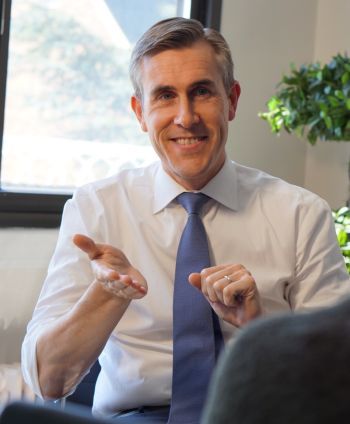
David Chauvin: News, man.
Last week, the felony conviction of former President Donald Trump commanded multiple pages in every national newspaper, and of course an endless stream of punditry on every news channel.
Because cameras were banned from the courtroom, the trial was reported by TV anchors like color commentators on “Monday Night Football” – essentially, after-the-fact analysis. And, like every great reality show, it was not the actual developments but the implications that drove the excitement.
Very quickly, discussions turned from balls and strikes to assessing electoral effects of the verdict – the fallout with independent voters, the potential to rally donors and supporters, polling in Midwestern swing states.
Long Island, known for its political diversity and active civic engagement, has become a microcosm of the national debate. Since the Trump verdict, local and regional news outlets across the region – featuring a lengthy lineup of former and current elected officials – have presented a seemingly endless stream of special guests, op-eds and letters-to-the-editor spanning the entire political spectrum.
Former Speaker of the House Tip O’Neill may have been right in the 1980s, when he noted that “all politics is local,” but in 2024, all politics is national. More people get their local news via digital outlets, so the local connection to the national news cycle is pervasive.
According to the Pew Research Center, almost 60 percent of Americans are closely following news about the 2024 presidential candidates. However, this heightened engagement comes with a cost, as an even greater percentage (62 percent) already feels worn out by the extensive coverage.
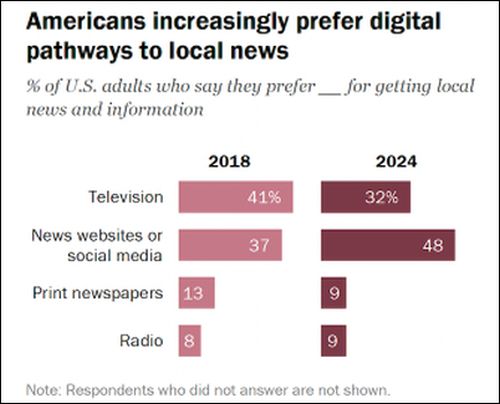
Digital domain: A majority of Americans now get their news from digital sources. (Source: Pew Research Center)
Election-coverage fatigue is not uniformly distributed across the political spectrum. According to Pew, compared to Democrats, Republicans – particularly conservatives – are slightly less likely to feel exhausted by the constant stream of political news. This discrepancy could be attributed to differing levels of media trust and engagement with various news sources.
Regardless, the overarching trend is clear: To stay relevant, everything needs to connect to political storylines, and a significant portion of the population feels overwhelmed by the continuous political noise.
This sense of fatigue is not new; similar levels of exhaustion were reported in the 2016 and 2020 election years. The difference now is the intensity and volume of the news, which has increased alongside the stakes.
Maybe all this election fatigue is driving viewers to more wholesome programming – part of the reason the Australian children’s show “Bluey” – the second-most streamed show in the United States – accounts for 29 percent of the watch time on Disney+. Not Spider-Man, not Mickey Mouse, not any of the “Star Wars” programs.
Granted, the show is not without its concocted political controversies. But “Bluey” provides a stark contrast to the high-stakes world of political news.

Am I Bluey: Yes, you are … and your gentle ways have won over election-fatigued American audiences.
Its episodes focus on the playful adventures of a young puppy and her family, offering simple yet profound lessons in kindness, family and everyday joy. Its popularity reveals a public yearning for uplifting, heartwarming and relatable content, a balm for the weary soul.
In this era of relentless news cycles, perhaps the best way to stay grounded is to occasionally switch off the political drama and tune into something gentler. And when it comes to marketing, this might be the best way to engage with potential customers and target audiences – finding joy in the little things could be the antidote we need to navigate the complexities of our times.
But don’t be surprised by a news cycle bombarded with election news straight through November. Disney may be high-fiving now because of its low-cost Australian megahit, but if we learned anything from 1994, it’s that the news cycle always wins.
David A. Chauvin is executive vice president of ZE Creative Communications.