
By DAVID A. CHAUVIN //
In one memorable episode of “Mad Men,” Sterling Cooper merges into the tongue-twisting Sterling Cooper Draper Pryce, igniting a chaotic clash of egos and overlapping roles as the reformed agency struggles to find its footing.
 Today’s realities seem to be mirroring fiction.
Omnicom and Interpublic, two titans of advertising, have announced a merger that would create the world’s largest advertising conglomerate – a real-life Sterling Cooper Draper Pryce with a balance sheet to match.
This historic merger signals more than a financial milestone; it represents a profound shift in the industry’s landscape, bringing efficiency and technological innovation to the forefront while raising critical questions about competition, creativity and the consumer experience.
On Long Island, public relations and marketing have long been rooted in collaboration and creativity. But it’s the individual approaches that make it such a special regionalized industry, serving one of the country’s largest media markets.
This region’s PR industry was built on the vision of leaders like Katherine Heaviside, Gary Lewi, Bert Cunningham and our founding partners, Robert Zimmerman and Ron Edelson. Their legacies remind us of the importance of fostering independent thinking and diverse ideas, and the competition between us serves as an inspiration to further advance the ways in which our respective clients are positioned among their target audiences.

David Chauvin: Independent thinker.
Creativity and innovation are fueled by new ideas, new approaches and mutual respect for others within your industry – especially in marketing, advertising and public relations, which help steer perception and connection. If they were to have joined forces, Long Island’s institutions would not have the same level of relationship with the people who work and live here.
And that is the danger of the Omnicom/Interpublic merger.
The current advertising landscape – dominated by a few mega-agencies – stands in stark contrast to the inclusive and innovative spirit cultivated by our regional pioneers. On Long Island and beyond, it’s imperative to protect spaces where smaller agencies can thrive and new voices can emerge.
The Omnicom/Interpublic combo would mark Madison Avenue’s biggest deal to date. These are both storied giants as individual agencies and as holding companies, with campaigns like Mastercard’s “Priceless” and Apple’s “Think Different” shaping cultural touchpoints.
Omnicon Group includes iconic agencies BBDO, TBWA Worldwide and FleishmanHillard, plus ad buyer Omnicom Media Group; its client roster includes Disney, AT&T and PepsiCo.
The Interpublic Group of Companies owns agencies such as McCann Worldgroup, Weber Shandwick, FCB Global and ad-buying firm IPG Mediabrands; its client roster includes L’Oréal, Johnson & Johnson and Geico.
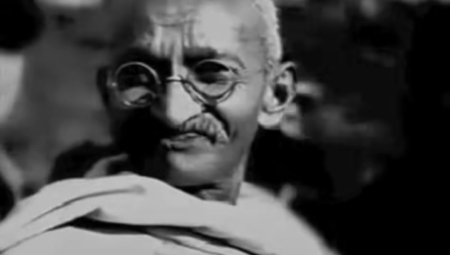
Creative spark: Apple’s “Think Different” ads basically slapped a Richard Dreyfuss voiceover onto 60 seconds of historic B-roll footage — but reign as a creative-marketing champion thanks to their undeniable humanity.
Their $25 billion in combined annual revenue would dwarf current market leader WPP, which owns high-profile advertising companies Ogilvy and VML, among many others. The merger – which aims to consolidate operations, harness advanced artificial-intelligence technologies and challenge Silicon Valley giants like Meta, Amazon and Google – has the potential to shift the industry power dynamic.
But the behemoth’s rise comes at a cost. As the Big Four ad-holding companies evolve into the Big Three (with Publicis Groupe and WPP rounding out the trio), the advertising industry’s consolidation threatens independent agencies and the creative spark that often originates in smaller firms.
The promise of a merged Omnicom-Interpublic is efficiency: streamlined operations, enhanced AI capabilities, a full-spectrum suite of services. But such efficiencies inevitably lead to redundancies, layoffs and the erosion of independent voices. Experts already predict that automation and consolidation could eliminate tens of thousands of creative roles by 2030; now the artistry that once defined advertising risks being overshadowed by formulaic, data-driven strategies.
Advertising and marketing thrive on bold ideas and innovation – a world without creativity like “Got Milk?” risks becoming a world without stories that move us, subsumed instead by analytics and algorithms.
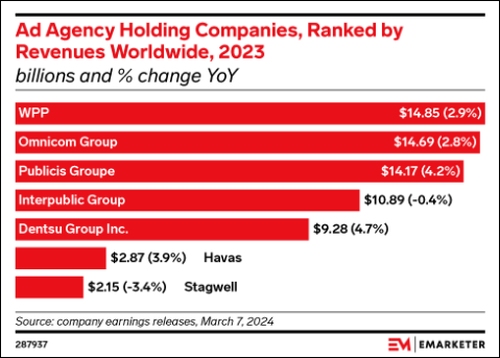
Creating a monster: Interpublic and Omnicom are already two of the four largest ad-holding companies by annual revenue. (Source: eMarketer)
Proponents of the Omnicom/Interpublic merger argue that scale is vital to compete with the precision-targeting capabilities of tech giants. Partnerships with Google and Microsoft have fueled rapid advancements in generative AI, enabling campaigns to be crafted at unprecedented speeds and scales, but as AI becomes central to advertising, there’s a growing concern about its impact on originality and human connection.
Artificial intelligence may promise efficiency, but it cannot replicate the emotional resonance of a well-crafted slogan or an evocative image. It’s the balance between art and technology that has always propelled advertising forward – a balance at risk in an increasingly automated world.
For consumers, the merger’s implications extend beyond the ads themselves. A single entity controlling vast portions of the ad-buying market could drive up costs for brands and, ultimately, the products we buy. More troublesome is the notion of fewer companies shaping advertising, narrowing the diversity of ideas that reflect our society’s richness.
Regulatory oversight will be crucial. Antitrust authorities must weigh the merger’s potential benefits against its risks, ensuring that competition and consumer choice are preserved in an industry poised to surpass $1 trillion in global ad spending annually.
As Omnicom and Interpublic rush toward creating the ultimate advertising powerhouse, we must pause to consider the stakes. Consolidation may deliver efficiencies, but it risks eroding the soul of the industry: creativity, diversity and the human stories that connect us all.
Long Island’s public relations industry offers a powerful lesson in the value of independence and innovation. As the advertising world evolves, it’s our collective responsibility – as regulators, clients and consumers – to ensure that the pursuit of progress doesn’t come at the expense of artistry and competition.
Advertising is about more than selling products. It’s about telling stories. And the best stories, like the ones that shaped Long Island’s PR legacy, can never be monopolized.
David A. Chauvin is executive vice president of ZE Creative Communications.